


Best Prior Authorization Software in 2026: A Buyer's Guide for Clinics and Health Systems
Prior authorization software has become a non-negotiable investment for any practice processing more than 50 PAs per month. This guide evaluates the leading platforms across the criteria that matter most.


Prior authorization software has become a non-negotiable investment for any practice processing more than 50 PAs per month. The math is unambiguous: the CAQH 2024 Index puts the manual cost of a single prior authorization at $10.97 for providers, while fully electronic processing drops that to $5.79. Multiply the difference across hundreds of monthly authorizations and you're looking at tens of thousands of dollars in annual savings, before you factor in faster turnaround times, higher approval rates, and reduced coordinator burnout.
The trend line keeps pointing the same way. The 2025 CAQH Index, released in February 2026, found that electronic transactions and better data exchange helped U.S. healthcare avoid an estimated $258 billion in administrative costs, a 17 percent year-over-year increase in cost avoidance. CAQH still estimates roughly $21 billion in savings left on the table from transactions that remain manual or partially manual, and prior authorization is one of the biggest contributors. The cost of doing this by hand is not going down.
But the market has gotten crowded. Between established players, EHR-native tools, and a wave of AI-driven startups, choosing the right platform requires understanding not just what each product does today, but how well it's positioned for the CMS 2026 and 2027 mandates that are reshaping how prior authorization works at a regulatory level.
This guide evaluates the leading platforms across the criteria that matter most to specialty practices, primary care groups, and FQHCs: EHR integration depth, payer coverage, automation capabilities, CMS compliance readiness, and real-world cost.
What Changed in 2026 (And Why Your Current Process Probably Isn't Enough)
Three regulatory shifts hit on January 1, 2026 that make PA software more critical than ever:
The CMS Interoperability and Prior Authorization Final Rule (CMS-0057-F) now requires Medicare Advantage plans, Medicaid managed care organizations, and QHP issuers to respond to standard PA requests within 7 calendar days (down from 14) and urgent requests within 72 hours. Every denial must include a specific reason: no more generic "not medically necessary" rejections without explanation.
By March 31, 2026, these payers must publicly report their approval rates, denial rates, appeal overturn rates, and average response times. For the first time, providers will be able to compare payer PA performance side by side.
And the biggest shift arrives January 1, 2027: payers must implement FHIR R4-based Prior Authorization APIs that let providers submit requests, check status, and receive decisions electronically through their EHR. The manual portal-hopping era has an expiration date.
The WISeR Program: What It Means If You Practice in These Six States
Alongside the interoperability rule, CMS launched a separate initiative in 2026 that changes the prior authorization calculus for traditional Medicare. The Wasteful and Inappropriate Service Reduction (WISeR) Model is a six-year CMMI pilot running from January 1, 2026 through December 31, 2031. It applies only to traditional Medicare fee-for-service: not Medicare Advantage, and not hospital inpatient care.
The model is live in six states: Arizona, New Jersey, Ohio, Oklahoma, Texas, and Washington. It uses AI and machine learning to screen requests, but every denial must be reviewed by a licensed clinician before it stands. Decisions come within 72 hours for standard requests and 48 hours for expedited ones, and CMS has signaled a gold-card-style exemption may follow for providers with strong track records.
WISeR is technically voluntary but functionally mandatory: claims for targeted services that aren't submitted for prior authorization face prepayment review instead. The targeted services include skin and tissue substitutes, electrical nerve stimulators, cervical fusions, epidural steroid injections, knee arthroscopy for osteoarthritis, and incontinence treatments. If you practice in one of the six states and perform these procedures, stronger clinical documentation and faster submission are now the difference between getting paid and fighting a prepayment review.
What's Coming in 2027: Electronic Prior Authorization for Drugs
The 2024 interoperability final rule deliberately left drugs out of scope: it covered non-drug items and services only. A new proposed rule closes that gap. The 2026 CMS Interoperability Standards and Prior Authorization for Drugs Proposed Rule (CMS-0062-P) was released on April 10, 2026, published in the Federal Register on April 14, 2026, with comments due June 15, 2026.
It extends electronic prior authorization to drugs using three NCPDP standards (SCRIPT, Formulary & Benefit, and Real-Time Prescription Benefit), with a proposed compliance date of October 1, 2027. Medical-benefit drugs would route through the FHIR PA API, while pharmacy-benefit drugs would use the NCPDP standards. The impacted payers mirror the earlier rule: Medicare Advantage, Medicaid fee-for-service and managed care, CHIP, and qualified health plans on the federally facilitated exchanges. Employer-sponsored and ERISA plans are not covered. The proposal carries the same 24-hour urgent and 72-hour standard decision windows.
How We Evaluated These Platforms
We assessed each platform across six dimensions:
- EHR integration depth: Does it read/write natively to your EHR, or does it require manual bridging?
- Payer coverage: How many payer portals does it connect to, and does it handle the difficult ones (IPAs, state Medicaid, delegated vendors like eviCore)?
- Automation level: Does it just submit forms, or does it compile documentation, validate before submission, track status, and manage denials?
- CMS compliance: Is the vendor actively building toward FHIR API requirements and the 2027 mandate?
- Specialty fit: Does it serve your practice type: specialty, primary care, FQHC, or behavioral health?
- Pricing transparency: Can you model the cost before signing, or does pricing require a custom quote with no published benchmarks?
The Leading Platforms
CoverMyMeds (McKesson)
CoverMyMeds is the largest electronic PA platform in the market, processing over 43 million prior authorizations in Q1 2025 alone. It's integrated with 350+ EHRs and connects to most major payer networks.
Strengths: Massive payer network, free for providers on the prescription/pharmacy PA side, deep EHR integration for medication PAs, strong brand recognition with payers who accept CoverMyMeds submissions natively.
Limitations: CoverMyMeds' core strength is pharmacy and prescription drug PA: not medical/procedural PA. If you're a specialty practice that needs authorization for MRIs, surgeries, infusion therapy, or specialist referrals, CoverMyMeds covers only part of your workflow. It's also pharmacy-centric in its design, which means the interface and logic don't map cleanly to complex medical PA scenarios involving clinical documentation, specialist matching, or multi-step referral coordination.
Waystar (formerly Navicure + ZirMed)
Waystar positions PA automation as one module within its broader revenue cycle management platform. It connects to major payers and offers both rules-based automation and AI-assisted clinical documentation for PA submissions.
Strengths: Strong for organizations already using Waystar for claims, eligibility, or denial management: the PA module shares data with those workflows, reducing duplicate data entry. Good payer connectivity for commercial and Medicare plans.
Limitations: PA automation isn't Waystar's core product: it's a feature within a much larger RCM suite. That means you're often buying (and implementing) more platform than you need if PA is your primary pain point. Implementation timelines for the full suite can stretch to 3-6 months. Pricing is enterprise-oriented and not published.
Myndshft
Myndshft is purpose-built for prior authorization automation and has gained traction for its AI-driven approach to PA determination and submission. It connects to EHRs and payer systems to automate the determination of whether PA is required, what documentation is needed, and submission through electronic channels.
Strengths: Focused entirely on PA, which means the product is deeper on authorization-specific workflows than platforms where PA is one of many features. Includes real-time PA determination (checking whether auth is required before submission), which prevents unnecessary submissions. Growing payer network.
Limitations: Smaller payer network compared to CoverMyMeds or Availity. EHR integration depth varies: works well with major EHRs but may require workarounds for smaller or niche systems. Less established track record at scale compared to larger competitors.
Availity (with Payer-Specific Modules)
Availity functions as the dominant multi-payer hub for provider-payer transactions, serving as the primary portal for Anthem, Aetna, Humana, most BCBS plans, and Cigna/HealthSpring. Its Authorizations & Referrals module supports real-time PA submission and status tracking.
Strengths: If your payer mix is heavy on Anthem, Aetna, Humana, or BCBS, Availity is likely already your submission channel. Free registration for providers. Supports real-time submissions to connected payers. Interactive Care Reviewer (ICR) tool for Anthem can auto-approve 40+ common procedures instantly.
Limitations: Availity is a portal and clearinghouse: not an automation platform. It streamlines submission but doesn't automate documentation compilation, EHR data extraction, or proactive status monitoring. You still need someone to log in, gather documentation, and submit. It's the highway your PA travels on, not the driver.
Rhyme (formerly Olive AI's PA module)
Rhyme emerged from Olive AI's pivot and focuses on AI-driven prior authorization for health systems. It uses AI to predict PA requirements, compile clinical documentation, and submit requests through connected payer channels.
Strengths: AI-native approach with strong clinical documentation intelligence. Good fit for hospital-based workflows and inpatient PA requirements. Growing integration ecosystem.
Limitations: Primarily targets health systems and hospitals: less relevant for independent specialty practices or small-to-mid-size groups. Enterprise pricing and implementation model. Relatively new as a standalone company after Olive AI's restructuring.
Linear Health
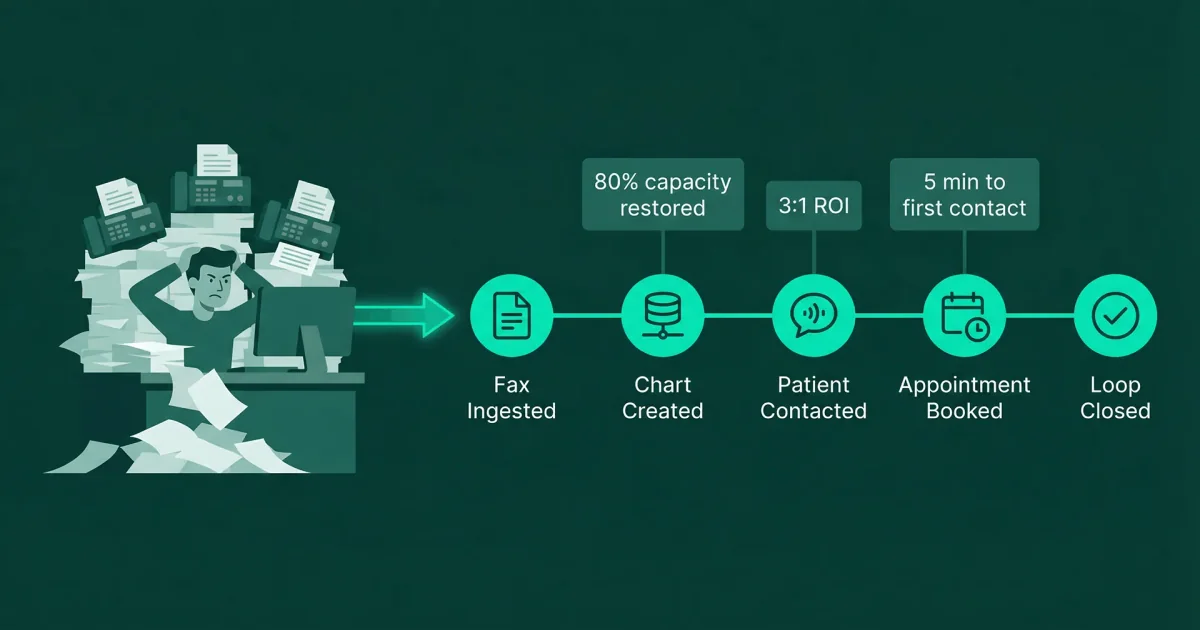
Linear Health takes a different approach from the platforms above: rather than treating PA as a standalone transaction, it automates PA as part of the entire referral coordination workflow: from the moment a referral order is placed in the EHR through specialist matching, patient engagement, appointment scheduling, and closed-loop documentation.
Strengths: End-to-end workflow automation that connects PA to referral coordination, specialist matching, and patient engagement in a single platform. Deep Athena Health integration with native EHR read/write capabilities. Purpose-built for specialty practices and primary care groups managing high referral volumes. Handles complex payer portals including Dignity Health, LA Care, IPA plans, and delegated vendors. Live in 2-4 weeks for Athena practices. Combines PA submission with multi-channel patient outreach (SMS, email, voice AI) to ensure patients actually schedule after authorization.
Limitations: Strongest fit is practices on Athena Health: while it supports other EHRs via HL7 and API, the deepest automation is with Athena's Authorization Management Service. Not designed for prescription/pharmacy PA. Best suited for practices with referral-driven PA volume rather than purely procedural PA.
Comparison Matrix
| Capability | CoverMyMeds | Waystar | Myndshft | Availity | Rhyme | Linear Health |
|---|---|---|---|---|---|---|
| Pharmacy PA | Strong | Limited | Limited | Limited | Limited | No |
| Medical/Procedural PA | Limited | Strong | Strong | Moderate | Strong | Strong |
| EHR Integration | 350+ | Major EHRs | Major EHRs | Portal-based | Health system EHRs | Deep Athena |
| AI Documentation | No | Yes | Yes | No | Yes | Yes |
| Referral Coordination | No | Limited | No | No | No | End-to-end |
| Patient Outreach | No | No | No | No | No | SMS, Email, Voice AI |
| FHIR API Ready | In progress | In progress | Yes | Partial | Yes | Yes |
| Drug PA Capability | Strong | Moderate | Moderate | Limited | Limited | No |
| WISeR Readiness | Limited | Moderate | Moderate | Limited | Moderate | Strong |
| Best Fit | Pharmacy-heavy practices | Large health systems | Mid-size groups | All (as clearinghouse) | Hospitals | Specialty + PCP on Athena |
Swipe to compare all 6 platforms →
How to Choose: Matching Platform to Practice Type
If you're a specialty practice on Athena Health managing 100+ outbound referrals monthly, you need a platform that automates the complete referral-to-authorization-to-appointment workflow. Linear Health is purpose-built for this exact scenario.
If you're a large health system with Epic or Cerner and your PA volume is primarily hospital-based procedures and inpatient care, Rhyme or Waystar integrate more naturally with enterprise EHR workflows.
If your primary PA challenge is prescription drugs and pharmacy benefits, CoverMyMeds remains the market leader with the broadest payer connectivity for medication PA.
If you're a mid-size practice looking for pure PA automation without broader workflow features, Myndshft offers focused functionality without the weight of a full RCM suite.
If you're an FQHC managing multiple MCO plans with Medicaid-driven PA complexity, you need a platform that handles the payer fragmentation unique to community health centers. Platforms with strong Athena integration and care gap closure capabilities offer the most complete solution for FQHC workflows.
Questions to Ask During Vendor Evaluation
Before signing with any PA automation vendor, get clear answers on these:
- Which payer portals do you actively submit to today? Ask for the specific list: not "hundreds of payers" but the actual portal names relevant to your payer mix.
- What's your first-pass approval rate across your customer base? Vendors who can't answer this with a specific number likely aren't tracking it. Look for 90%+ at minimum.
- How does your platform handle denied PAs? Automated resubmission? Peer-to-peer scheduling? Appeal letter generation? The denial workflow matters as much as the submission workflow.
- What's your FHIR API roadmap for CMS 2027? Any vendor telling you they'll "figure it out when the time comes" is behind. The best platforms are already piloting FHIR-based PA workflows with major payers.
- What does your pricing look like at 2x our current volume? If you're growing, you need to know whether the economics improve or deteriorate as PA volume increases.
- Can I see the platform working with my EHR in a live demo? Screenshots and slide decks don't reveal integration depth. Watch it detect an order, compile documentation, and submit: live, in your EHR environment.
The Landscape Is Shifting Fast
The PA software market in 2026 looks very different from where it was two years ago. The CMS mandate is forcing payers toward electronic PA, which means the platforms that have invested in FHIR infrastructure and deep payer connectivity will pull ahead. At the same time, the line between PA automation and broader workflow automation is blurring: practices increasingly want platforms that don't just get the authorization, but ensure the patient actually receives the care that was authorized.
The worst decision you can make right now is no decision. Every month of manual PA processing costs your practice thousands in direct labor, tens of thousands in delayed revenue, and an unmeasurable amount in coordinator burnout and turnover. Pick a platform. Get it live. Iterate from there.
Is Linear Health right for you?
Consider Linear if
- You are on Athena Health
- You handle 100+ prior auths a month
- Your coordinators are buried in manual submission and follow-up work
- You want prior auth, scheduling, and outreach in one platform
Linear probably is not for you if
- You only need pharmacy prior auth (CoverMyMeds handles that)
- You are a large health system on Epic (look at Rhyme or Waystar)
- You want the lowest price with the least setup
Related Reading
- The Complete Prior Authorization Cheat Sheet
- How to Speed Up Prior Authorization for Specialists
- Best Referral Management Software for Healthcare in 2026
Frequently Asked Questions
What is the best prior authorization software in 2026?
What should I look for in prior authorization software?
How much does prior authorization software cost?
Does prior authorization software work with my EHR?
What is the WISeR program and how does it affect my prior authorization submissions?