



Aetna prior authorization automation: provider workflow guide
Aetna prior authorization automation should help provider teams distinguish notification from coverage determination, prepare complete packets, track status, and route exceptions safely.

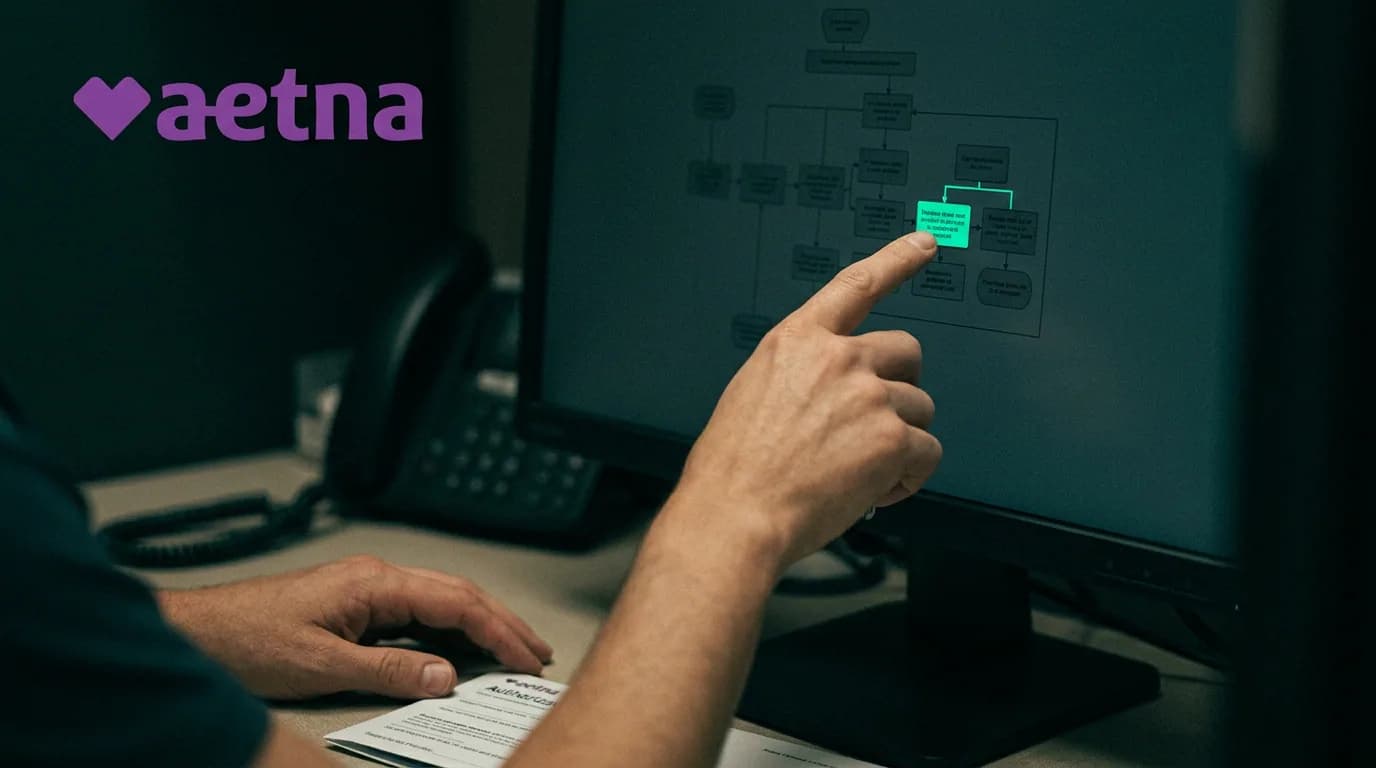
Aetna prior authorization work is a good example of why automation needs a precise boundary.
Provider teams need to check requirements, prepare documentation, submit or notify through the right workflow, track status, and handle exceptions. But coverage decisions and medical necessity review remain governed by plan documents and clinical criteria.
Quick answer
Aetna prior authorization automation should help provider teams identify whether a service is on the precertification list, distinguish notification from coverage determination, assemble required clinical documentation, track submission status, and route exceptions. Automation should support the process, while clinical coverage decisions remain governed by plan documents and medical review criteria.
This guide explains how to automate the provider-side workflow safely.
According to the AMA 2024 and 2025 Prior Authorization Physician Surveys, practices complete an average of 39 prior authorizations per physician each week and spend about 13 hours on them, and 93% of physicians say prior authorization delays patient care. In the 2025 AMA survey, 74% of physicians reported that denials have increased over the past five years, and roughly one in three said requests are often or always denied, so denial routing is now part of the core workflow, not an edge case.
This is part of our broader prior authorization automation work; see also prior authorization automation with AI and how long prior authorization takes.
What does Aetna require for precertification?
Aetna publishes precertification resources for healthcare professionals, including precertification lists and guidance for services that may require review before care is delivered. For providers, the practical workflow usually includes:
- Confirming member eligibility
- Checking whether the requested service requires precertification
- Gathering diagnosis and procedure details
- Preparing clinical documentation
- Submitting the request through the appropriate channel
- Tracking response
- Responding to missing-information requests
- Recording the result
The burden is operational. Staff need to know what is required, when, and for which patient. They also need to track what has already been sent.
What is the difference between notification and coverage determination?
Aetna describes notification as a data-entry process that does not require judgment or interpretation for benefits coverage. A coverage determination is different. It depends on plan documents and, where applicable, clinical information.
That distinction matters for automation.
Automation can support notification workflows by capturing and submitting required administrative information. It can support coverage determination workflows by assembling documentation, tracking status, and routing requests to the right humans. It should not replace clinical review. It should make the packet complete and the workflow reliable.
Which Aetna prior auth steps can be automated?
Automation can help with:
- Requirement lookup
- Patient and plan data capture
- Provider and facility data capture
- Diagnosis and procedure code collection
- Documentation checklist generation
- Clinical note retrieval for staff review
- Submission task preparation
- Status monitoring
- Deadline tracking
- Missing-information routing
- Denial reason capture
- Appeal packet support
The strongest workflow is not fully autonomous. It is supervised automation. Routine steps happen automatically, while exceptions go to the right person with the right context.
What documentation should be prepared first?
Before an Aetna prior authorization request is submitted, teams should confirm:
- Member information
- Plan details
- Ordering or requesting provider
- Rendering provider
- Service or procedure requested
- Diagnosis information
- Site of service
- Relevant clinical notes
- Test results or prior treatment history when applicable
- Payer-specific supporting documentation
Incomplete documentation creates avoidable delay. Even if the payer ultimately approves the request, missing information forces staff into rework. Automation reduces that burden by making completeness visible before submission.
How should denials and missing-information requests be routed?
Not every payer response should go to the same queue.
Missing-information requests should route to the team member who can supply the missing item. Administrative denials should route to staff who can correct the record or resubmit. Clinical denials should route to the clinician or reviewer responsible for appeal or peer-to-peer review.
The workflow should capture:
- Response date
- Reason
- Required next action
- Deadline
- Owner
- Supporting documentation needed
- Final outcome
If this information is tracked only in free-text notes, leaders cannot see patterns by payer, service, or location.
What to automate, what stays human
| Workflow step | Automate | Keep with a human |
|---|---|---|
| Requirement and eligibility lookup | Yes | No |
| Documentation assembly and completeness check | Yes | No |
| Submission and notification | Yes | No |
| Status tracking and deadline monitoring | Yes | No |
| Missing-information routing | Yes | Owner supplies the item |
| Medical-necessity and coverage judgment | No | Clinician or reviewer |
| Clinical denial and peer-to-peer | Assists (packet, scheduling) | Clinician |
Where Linear Health fits
Linear Health fits around the provider-side work that makes prior authorization manageable.
It can help clinics automate requirement checks, packet preparation, status tracking, denial routing, and EHR documentation. It can connect prior authorization to referral coordination and scheduling, so the clinic knows which patient, appointment, or referral is affected by a pending request. The goal is not to override Aetna criteria. The goal is to submit cleaner requests, reduce staff rework, and keep exceptions moving.
Linear Health completely transformed how we operate. They replaced five disconnected tools we were using to manage referrals, scheduling, and patient outreach.
 Dr. Ashwin GowdaFounder & CEO, Texas Sleep Medicine
Frequently asked questions
Can Aetna prior authorization be automated?
What is the difference between notification and coverage determination?
What should staff prepare before submission?
Where does Linear Health fit?
Does Linear Health work with Aetna prior authorization specifically?
Sources: Aetna precertification, Aetna precertification lists, AMA 2025 Prior Authorization Physician Survey.