



AI-Powered Patient Scheduling and Outreach: Reduce No-Shows and Streamline Your Clinic's Workflow
Healthcare providers lose an estimated $150 billion annually to missed appointments. AI-powered scheduling and outreach automation changes the math through faster first contact, multi-channel outreach, self-scheduling, and intelligent follow-up.

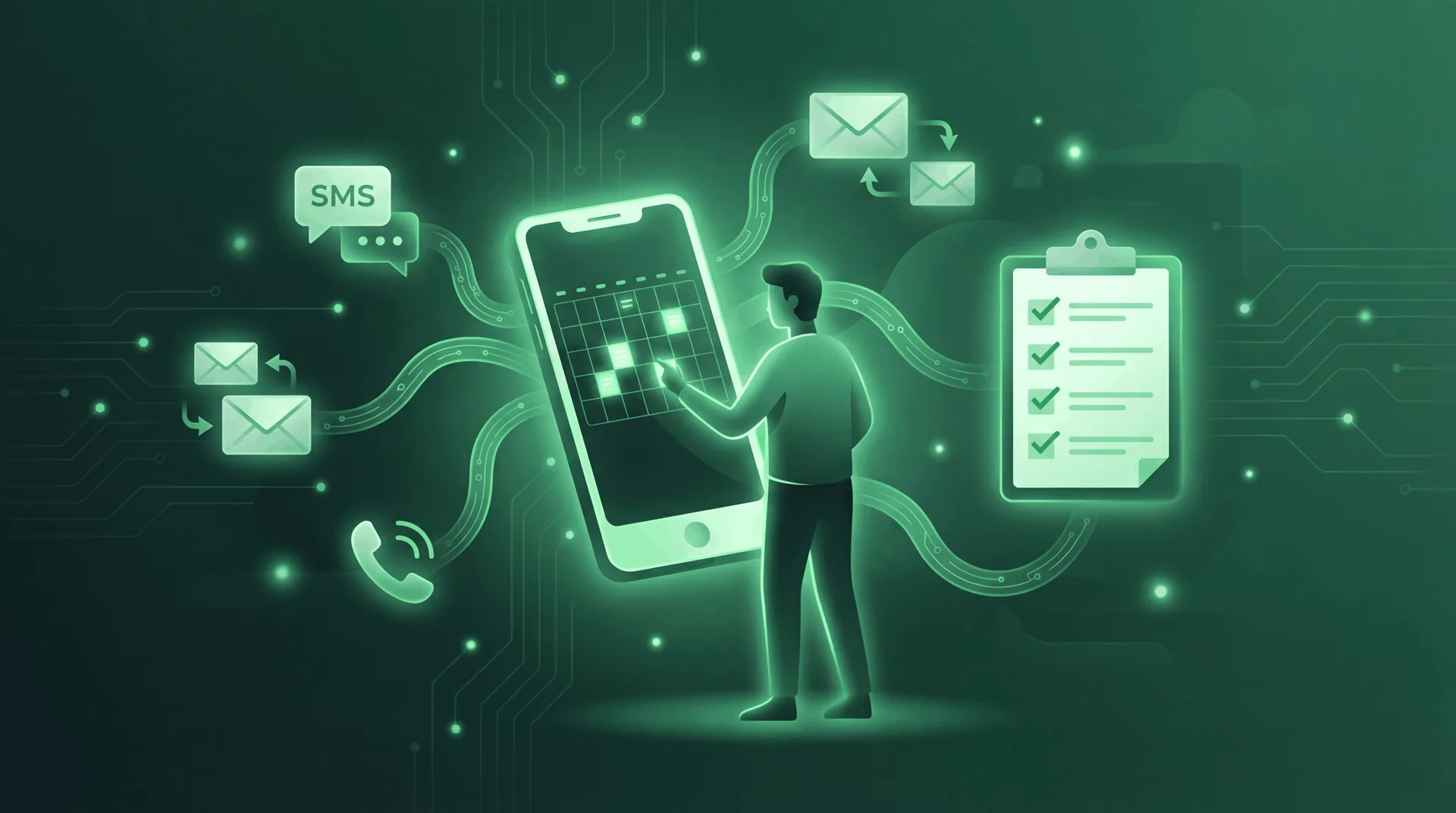
Healthcare providers lose an estimated $150 billion annually to missed appointments. For an individual specialty practice with 40 no-shows per month at $300 average revenue per visit, that is $144,000 per year walking out the door. For a multi-location group managing 200 no-shows monthly across sites, the math crosses $700,000.
The standard advice for reducing no-shows is a version of "remind patients about their appointments." This is true but incomplete. The practices that run no-show rates under 10% (versus the 18 to 30% average at specialty clinics) are not just sending reminders. They are fundamentally restructuring how patients move from referral to waiting room: faster first contact, outreach across multiple channels, self-scheduling that removes friction, and intelligent follow-up that adapts to patient behavior.
None of that is achievable manually at any meaningful volume. A practice processing 400 referrals per month cannot call every patient within an hour of referral receipt, text the ones who do not answer, offer evening scheduling links, send pre-visit instructions in the patient's preferred language, and follow up on cancellations, all while also processing faxes, submitting prior authorizations, and managing the front desk. The staff math does not work.
AI-powered scheduling and outreach automation changes the math. Here is how it works, what to look for when evaluating solutions, and how the competitive field breaks down.
Why do traditional scheduling methods fail?
The scheduling problem is not a single failure. It is a chain of small failures that compound:
Slow first contact kills conversion. When a PCP refers a patient to a specialist, the patient's motivation is highest in the moment. By the time your coordinator calls 3 to 7 days later (after manually processing the referral fax, creating the chart, and submitting any required prior authorization), the urgency has faded. Practices that contact referred patients within the first hour see measurably higher scheduling completion rates than those with multi-day delays.
Phone-only outreach misses most patients. Patients under 45 screen calls from unknown numbers at rates above 80%. Even patients who do answer are often unavailable during business hours, which is the only window most practices have staff making calls. The result: phone-only outreach produces contact rates of 20 to 30%.
Scheduling friction creates drop-off. If a patient has to call during business hours, wait on hold, answer insurance questions, and pick from available times in a single phone conversation, many will say "I'll call back" and never do. Every step of friction between "patient decides to schedule" and "appointment is confirmed" is a lost conversion.
No proactive follow-up after cancellations. When a patient cancels, the slot often stays empty. By the time someone notices, it is too late to fill. When a patient no-shows, manual follow-up may happen days later, if at all. These empty slots are revenue that evaporated.
Referred patients have no relationship with you. Unlike patients who call their own doctor, referred patients did not choose your practice. They do not know where your office is, what to expect, or whether their insurance covers the visit. Uncertainty compounds every other friction point.
How does AI-powered scheduling automation work?
AI scheduling and outreach addresses each failure point in the chain:
- Instant first contact. When a referral arrives (by fax, e-referral, or EHR order), the system contacts the patient within minutes via their preferred channel. No waiting for a coordinator to process the referral manually first.
- Multi-channel outreach. SMS, email, and voice AI work together. A patient who ignores three phone calls might respond to a text within minutes. A patient who does not check email gets a voice call in the evening. The system learns which channel each patient responds to and leads with it. SMS reminders have a 98% open rate compared to 20% for email, so the system starts there for most patients.
- Self-scheduling. Patients receive a link with available appointment slots pre-verified for their insurance and the specific service type. They tap a time. The appointment confirms. The EHR chart updates automatically. No phone tag, no hold times, no coordinator involvement for routine bookings.
- Automated reminders and confirmation. Personalized reminders go out at configurable intervals before the appointment. Interactive reminders let patients confirm, reschedule, or cancel directly from the message. Cancellations immediately trigger waitlist offers to the next patient in line.
- No-show recapture. When a patient misses an appointment, the system launches automated re-engagement within hours, not days. The outreach is personalized based on the patient's history and the clinical urgency of the visit. Patients can reschedule directly from the message.
- Intelligent scheduling optimization. The system matches patients with providers based on insurance acceptance, location, procedure requirements, availability, and patient preferences. For care gap closure campaigns, appointment types are pre-configured to match the specific screening needed.
What should I look for in a healthcare scheduling automation platform?
Five capabilities separate tools that reduce no-shows from tools that just send reminders:
Bidirectional EHR integration. The system must read patient data and provider schedules from the EHR and write appointment confirmations, cancellations, and status updates back. If staff have to manually update the EHR after a patient self-schedules, you have automated one step and created another manual step.
True multi-channel capability. SMS, email, and voice AI in a single platform, with the ability to adapt outreach cadence and channel selection based on patient response patterns. Not just "we can send texts and emails" but "we learn which channel this patient responds to and lead with it."
Self-scheduling with insurance verification. The patient's scheduling link should only show appointment types and providers that accept their insurance. Scheduling a patient into a slot that requires a prior auth they do not have, or with a provider who does not accept their plan, creates a worse experience than no automation at all.
Connection to the referral workflow. Scheduling does not exist in isolation. The best scheduling automation begins when the referral arrives, not after someone has manually processed it. Systems that connect referral intake, prior authorization, and scheduling into one flow reduce the total time from referral to completed appointment, not just the time from "patient called back" to "appointment booked."
Reporting that tracks conversions, not just messages sent. The metric that matters is not "we sent 400 reminder texts." It is "of 400 referred patients, 340 scheduled, 310 showed up, and 280 completed their visit." End-to-end conversion tracking across the full referral-to-visit funnel shows where patients drop off and where the system needs adjustment.
What are the leading AI patient scheduling solutions?
| Vendor | Core Strength | Multi-Channel | EHR Integration | Best Fit |
|---|---|---|---|---|
| Luma Health | Patient access platform; AI scheduling, reminders, waitlist management; 2.5M+ staff hours saved in 2025 | SMS, email, voice AI (Navigator), web, Google scheduling | Epic, Oracle, athenahealth, eCW, NextGen (70+ EHRs) | Enterprise health systems and large specialty networks |
| Phreesia | Intake, registration, and payment platform; scheduling and reminders | SMS, email. Less emphasis on voice AI. | Broad EHR integrations | Practices focused on intake and payment workflows |
| Notable Health | Enterprise AI operations platform; MUSC Health: 14,500 no-shows avoided (7.6% reduction) | SMS, email, web app, patient portal | Epic, Oracle, MEDITECH, athenahealth | Enterprise health systems with broad automation needs |
| Medsender | AI fax processing + referral scheduling; MAIRA voice AI agent; 80% less call handling | SMS, voice AI (MAIRA) | Dozens of EHRs; API for custom integrations | Small to mid-market practices wanting fax + voice + scheduling |
| TeleVox (Intrado) | Patient communication platform; appointment reminders, recall campaigns | SMS, email, voice (traditional IVR) | Broad legacy integrations | Practices wanting traditional reminder systems |
| Linear Health | Scheduling connected to referral intake, fax processing, PA automation, and care gap closure; triggers on referral arrival | SMS, email, voice AI. Adapts to patient preference. | Bidirectional: athenahealth, eClinicalWorks, NextGen, Greenway Health, Veradigm, Epic; 4-week go-live | Mid-market specialty practices, FQHCs, PE-backed groups |
Two things to notice. First, the market splits between platforms that treat scheduling as a standalone patient engagement feature (Luma, Phreesia, TeleVox) and platforms that treat scheduling as one step in a connected operational workflow (Linear Health, Notable). For practices where the scheduling problem is fundamentally a referral conversion problem, the connected approach delivers more impact because it addresses the upstream causes (slow fax processing, PA delays) that create the downstream scheduling failures.
Second, Luma Health is the strongest pure scheduling competitor. They serve 600+ health systems, have deep EHR integrations, and their Conversational AI concierge handles both inbound calls and outbound outreach. For enterprise health systems, Luma is a serious evaluation. For mid-market specialty practices and FQHCs that need scheduling tied to referral coordination, prior auth, and care gap closure without enterprise-scale complexity, that is where Linear Health's scheduling automation fits.
We were losing thousands in revenue to no-shows and delayed scheduling. Linear Health contacted our patients faster than we ever could and our show rates improved dramatically.
What is the ROI of AI scheduling and outreach automation?
No-show revenue recovery. A specialty practice with 40 monthly no-shows at $300 per visit loses $144,000 per year. Reducing no-shows by 40% (a typical result with multi-channel automation) recovers $57,600 annually. For multi-location groups, multiply accordingly.
Referral conversion improvement. Faster first contact and self-scheduling increase the percentage of referrals that convert to completed appointments. Improving referral completion by 15 percentage points across 400 monthly referrals at $300 per visit adds $216,000 in annual revenue.
Staff time reclaimed. Automated outreach, reminders, and self-scheduling reduce the volume of phone calls your staff makes and receives. Practices typically reclaim 15 to 25 hours per week of coordinator time, which can be redeployed to complex cases, patient-facing work, or managing higher referral volume without additional hires.
Combined first-year impact. For a mid-size specialty practice: $57K in recovered no-show revenue + $216K in improved referral conversion + $30K in staff time savings puts the return above $300K in year one.
Which types of practices benefit most?
Specialty practices (orthopedics, cardiology, oncology, gastroenterology, neurology, sleep medicine) with high referral volume and high per-visit revenue see the fastest ROI. Every referral that converts to a completed appointment is $200 to $500+ in revenue.
FQHCs and primary care groups benefit from scheduling automation tied to care gap closure campaigns. When a care gap is identified, automated outreach and scheduling close the loop without adding to the quality team's workload.
PE-backed multi-location groups use scheduling automation to standardize patient access across sites, reduce no-show rate variation between locations, and create portfolio-level conversion metrics investors can track.
Practices with high no-show rates (above 20%) see the most dramatic improvement from multi-channel outreach and self-scheduling. The higher your starting no-show rate, the more revenue you recover.
Less ideal fit: Practices with very low referral volume (under 50 per month) or practices where patients already self-schedule at high rates may see less incremental impact from scheduling automation.
Is Linear Health right for you?
Consider Linear if
- You are on Athena Health and want scheduling tied to your live calendar
- You send hundreds of outreach touches a month for gaps and recalls
- No-shows and unfilled slots are quietly costing you revenue
- You want scheduling, outreach, and intake in one platform
Linear probably is not for you if
- You just need patient messaging and reminders (Luma does that well)
- You are a large health system on Epic using native patient outreach
- Your scheduling is fully manual by choice and low volume
- You want the lowest price with the least setup
FAQ
How can AI reduce no-show rates at my clinic?
What are the benefits of multichannel patient outreach?
How does scheduling automation integrate with my EHR?
How quickly can AI scheduling be implemented?
What types of practices benefit most from AI scheduling and outreach?
Related reading