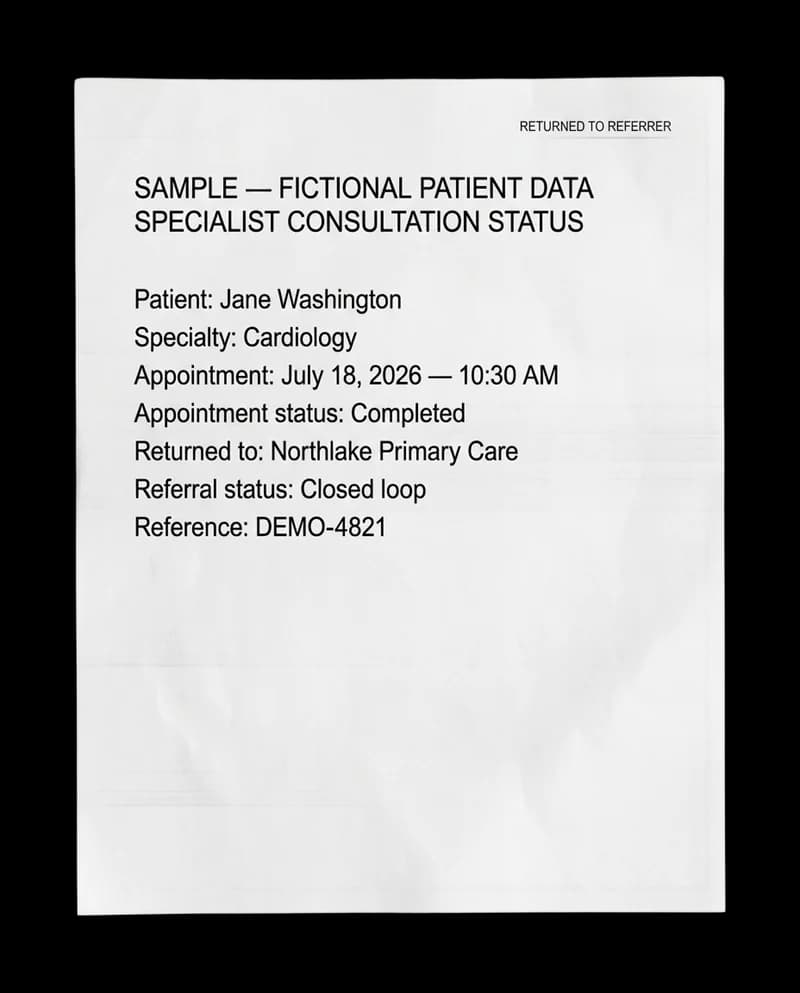


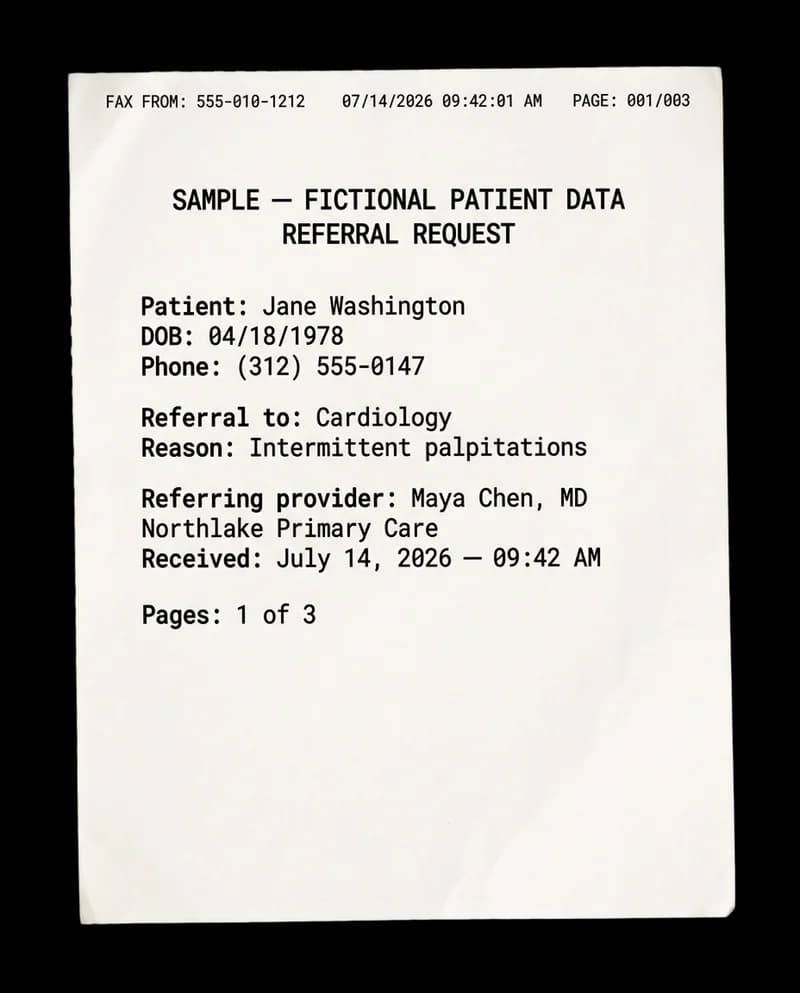
Intake · 01
Referral captured
- Patient
- Jane Washington
- Specialty
- Cardiology
- Received
- 09:42 AM
Structured from fax
Linear Health coordinates referrals across intake, scheduling, prior authorization, and follow-up, so your team stops chasing status updates and patients stop falling through the cracks. Built for FQHCs, specialty practices, and multi-site groups managing referral volume that manual workflows can't keep up with.
For most practices, a referral still moves through a patchwork of disconnected tools. Every handoff is a place it can stall, and every stall is a patient who waits or drops off entirely.
That creates delays. Referrals get lost. Patients miss appointments. Staff spend hours tracking down information that should already be visible.
The American Academy of Family Physicians has noted that incomplete ambulatory referrals often stem from missing information and communication failures. A peer-reviewed study in the International Journal of Medical Informatics found that roughly 30% to 50% of outpatient specialty referrals are not completed successfully.
Sources: AAFP; International Journal of Medical InformaticsLinear Health replaces that patchwork with one coordinated workflow, from referral intake through scheduling and follow-up.
Referral coordination software helps healthcare teams manage the full referral lifecycle in one connected workflow. It supports referral intake, patient outreach, scheduling, prior authorization, referral status tracking, and follow-up, so clinics reduce manual work and always know where each patient stands.

Tracking or documenting that a referral was sent.
The operational work of moving a patient from referral to scheduled care: intake, authorization, outreach, scheduling, follow-up, and closed-loop status.
For FQHCs, specialty practices, and multi-site groups, referrals move across multiple locations, providers, specialties, and payers. Coordination software tracks each one from start to finish and flags when something stalls, instead of relying on spreadsheets and manual calls.
A single referral can require intake review, insurance verification, prior authorization, patient outreach, scheduling, specialist confirmation, a status update back to the referring provider, and follow-up if the patient never books. When that runs on manual work, leakage becomes almost inevitable.
Patients fall through the cracks. Staff lose visibility. Providers don't know whether the patient was ever seen. The practice loses revenue from unscheduled visits. Patients face delays that can affect outcomes.
For private practice networks and multi-site groups, that manual burden multiplies with every location and specialty added.
Linear Health gives practices one coordinated workflow across every step, so each handoff is visible and actionable instead of buried in an inbox or a spreadsheet.
Linear Health captures every referral into one structured intake workflow, so nothing depends on an inbox or someone's memory.
Linear Health brings patient outreach, specialist confirmation, and status tracking into one coordinated process, so coordinators stop calling down a list to find out where each referral stands.
Linear Health automates patient outreach and flags referrals that still need action before they go cold.
Linear Health keeps authorization steps connected to the referral workflow, so payer delays don't freeze the whole process.
Linear Health gives one view of open, delayed, scheduled, and completed referrals across every site.
The right platform should support the operational reality of referrals, intake, scheduling, authorization, communication, and follow-up, not just basic referral tracking.
Captures incoming referrals from fax, portal, phone, and EHR, so fewer are lost before they are worked.
Shows whether a referral was sent, received, scheduled, completed, or still pending with an outside specialist.
Moves patients from referral to booked appointment with fewer manual steps.
Keeps authorization connected to the referral workflow, so payer delays do not stall scheduling.
Consistent outreach via SMS, voice, and email, so staff are not calling every patient by hand.
athenahealth specialist. Four established EHR integrations.
A clear view of open, delayed, scheduled, and completed referrals across all locations.
Connects referral completion to broader care gap initiatives, so unfinished referrals do not become permanent gaps.
Linear Health supports all of these in one connected platform, instead of stitching together point tools to cover the full workflow.
Linear Health connects referral tracking, scheduling, prior authorization support, patient outreach, and care gap closure into one workflow, built for teams that coordinate complex patient journeys without adding manual work.
Community health organization in the Chicago area, more than 100 providers across more than 20 locations, on athenahealth. Referral coordination, care gap closure and voice AI running across the network.
Read the case studyLinear Health is especially useful for teams that need to:
First workflow live in 4 weeks. Linear runs on top of your existing EHR rather than replacing it. athenahealth, NextGen, eClinicalWorks, and Greenway Health are established integrations, connected through standard health-data interfaces, and booked appointments and status updates are written back into your chart. Explore EHR integration scope.
Manual referral workflows often work until volume grows. Then they get hard to control, because they depend on staff remembering every step and having time to execute it.
| Workflow area | Manual coordination | Linear Health |
|---|---|---|
| Referral tracking | Spreadsheets, inboxes, faxes | Centralized workflow visibility |
| Patient follow-up | Manual calls and reminders | Automated outreach support |
| Scheduling status | Staff check manually | Clearer status tracking |
| Prior authorization | Often handled separately | Connected workflow support |
| Referral leakage | Hard to detect quickly | Easier to spot at-risk referrals |
| Staff workload | High manual effort | Reduced repetitive follow-up |
| Leadership visibility | Limited reporting | Operational insight across sites |
| EHR integration | Copy-paste or dual entry | athenahealth specialist. Four established EHR integrations. |
The problem with manual workflows is not that staff are inefficient. It is that the process needs human memory and attention at every handoff, and as volume grows, those handoffs multiply faster than staff capacity can keep up.
Many legacy referral tools were built to handle one part of the process: sending referrals, receiving them, or documenting activity. Modern practices need coverage across the full journey, intake, eligibility and authorization, scheduling, communication, specialist confirmation, status tracking, and care gap closure.
Referral leakage rarely happens at a single step. It happens when handoffs are disconnected and no one has a complete view.
A tool that solves only one part leaves the other handoffs exposed. Linear Health is built for teams that need a connected workflow, not just another place to document referral activity.

Specialty practices face high referral volume, payer requirements, and scheduling complexity. The gap between referral receipt and a scheduled appointment is where revenue and patient outcomes are most at risk. Linear Health supports intake, scheduling coordination, prior authorization, and status visibility, shrinking the time from referral to completed appointment.
FQHCs and community health centers manage high patient volume, complex needs, and limited administrative capacity, an environment where referral leakage is common and hard to detect. Linear Health helps track referrals, coordinate follow-up, close care gaps, and reduce the manual outreach burden on coordinators.
When each location coordinates referrals differently, leadership loses visibility and patients get inconsistent follow-up. Linear Health centralizes coordination across locations, making bottlenecks visible and workflows consistent at the network level.
Primary care groups manage outbound referrals to specialists, imaging, and community resources. The challenge is knowing whether the patient completed the next step. Linear Health tracks referral status and follows up when patients do not schedule, supporting care coordination and care gap closure across the panel.
For teams focused on a specific direction of referral flow, see outbound referral coordination and inbound referral coordination.
Referral leakage happens when a patient is referred but never completes the intended next step. It is one of the largest sources of lost revenue and missed care in ambulatory settings, and in manual workflows it stays invisible until the damage is done.
Each of these is a handoff. And each handoff in a manual workflow is a moment where something can fall through without anyone noticing.
The referral was never received by the specialist
The patient was never contacted after the referral
Authorization was delayed and scheduling stalled
Scheduling started but was never completed
The specialist never confirmed receipt
The referring provider never got a status update
Staff did not have time to follow up before it went cold
Care gaps often exist because patients do not complete referred care: follow-up visits, screenings, diagnostics, or specialty appointments. In many cases the gap is not a clinical failure. It is a coordination failure. Someone needed to follow up, and no one did.
Referral coordination software supports care gap closure by tracking whether patients complete the care they were referred for, creating a closed loop between the referral and the outcome instead of leaving the outcome unknown.
As more practices operate under value-based contracts with payers like CMS, care gap closure becomes a direct financial metric. Unresolved referrals are not just a patient-care issue, they affect quality scores, risk adjustment, and contract performance.
Linear Health supports care gap closure by coordinating outreach, scheduling, tracking, and follow-up around patient needs, valuable for FQHCs, primary care, and specialty networks managing large panels where gaps accumulate when referral follow-through is inconsistent.
Referral coordination software helps healthcare teams manage referrals from intake through scheduling, authorization, follow-up, and completion. It gives clinics an organized way to track referral status, reduce manual work, and prevent patients from falling through the cracks.
The best referral coordination software should support referral intake, outbound referral tracking, scheduling workflows, prior authorization coordination, patient outreach, reporting, and care gap closure. Linear Health is built to support these connected workflows for teams managing complex referral operations.
It reduces leakage by helping teams track which referrals are open, which patients have not scheduled, which are delayed, and which need follow-up, so teams can intervene before a referral is missed or abandoned.
Yes. It can keep prior authorization steps connected to the broader referral workflow, which matters because authorization delays often prevent patients from being scheduled in time.
Yes. Linear Health supports FQHCs and community health centers by helping teams coordinate referrals, patient outreach, scheduling, and care gap closure, reducing manual work and improving visibility across patient populations.
Linear Health supports specialty referral workflows by helping teams manage referral intake, scheduling coordination, prior authorization support, patient follow-up, and referral status tracking, useful for specialty practices with high referral volume and complex scheduling.
Referral management usually means tracking or documenting referrals. Referral coordination is broader: the operational work of moving a patient from referral to scheduled care, including intake, authorization, outreach, scheduling, follow-up, and status visibility.
Practices often manage referrals across multiple providers, locations, specialties, and payer requirements. Manual tracking becomes difficult because staff must coordinate many handoffs without a centralized view of referral status.
It reduces repetitive follow-up, centralizes referral status, supports patient outreach, and makes it easier to identify which referrals need action, so staff spend less time chasing information.
Yes. It can help close care gaps by tracking whether patients complete referred care, follow-up appointments, screenings, diagnostics, or specialty visits. Linear Health supports workflows that help teams identify and act on these gaps.
Referral coordination should not require endless spreadsheets, phone calls, faxes, and manual status checks. Every hour a coordinator spends chasing a referral is an hour not spent on the cases that actually need human judgment. Linear Health helps FQHCs, specialty practices, and multi-site groups manage referral workflows with better visibility and less administrative burden, so your team can reduce leakage, speed up scheduling, support prior authorization, and close care gaps more efficiently.


Get the latest on AI healthcare coordination.