

Aledade vs Linear Health: value-based care network or operations automation?
Aledade and Linear Health solve different primary care problems. One supports value-based care participation. The other automates the operational work that helps patients complete the next step in care.


Some comparisons are useful because two companies compete directly.
Others are useful because buyers confuse categories.
Aledade vs Linear Health belongs in the second group. A primary care organization may evaluate both, but not for the same job.
Quick Answer
Aledade and Linear Health solve different primary care problems. Aledade is publicly positioned as a physician-led value-based care company that helps primary care organizations succeed in accountable care. Linear Health is an operational AI platform that automates referrals, prior authorization, scheduling, and care-gap work. Many primary care groups may evaluate both, but for different jobs.
This article helps primary care leaders separate value-based care strategy from the operational work required to execute it.
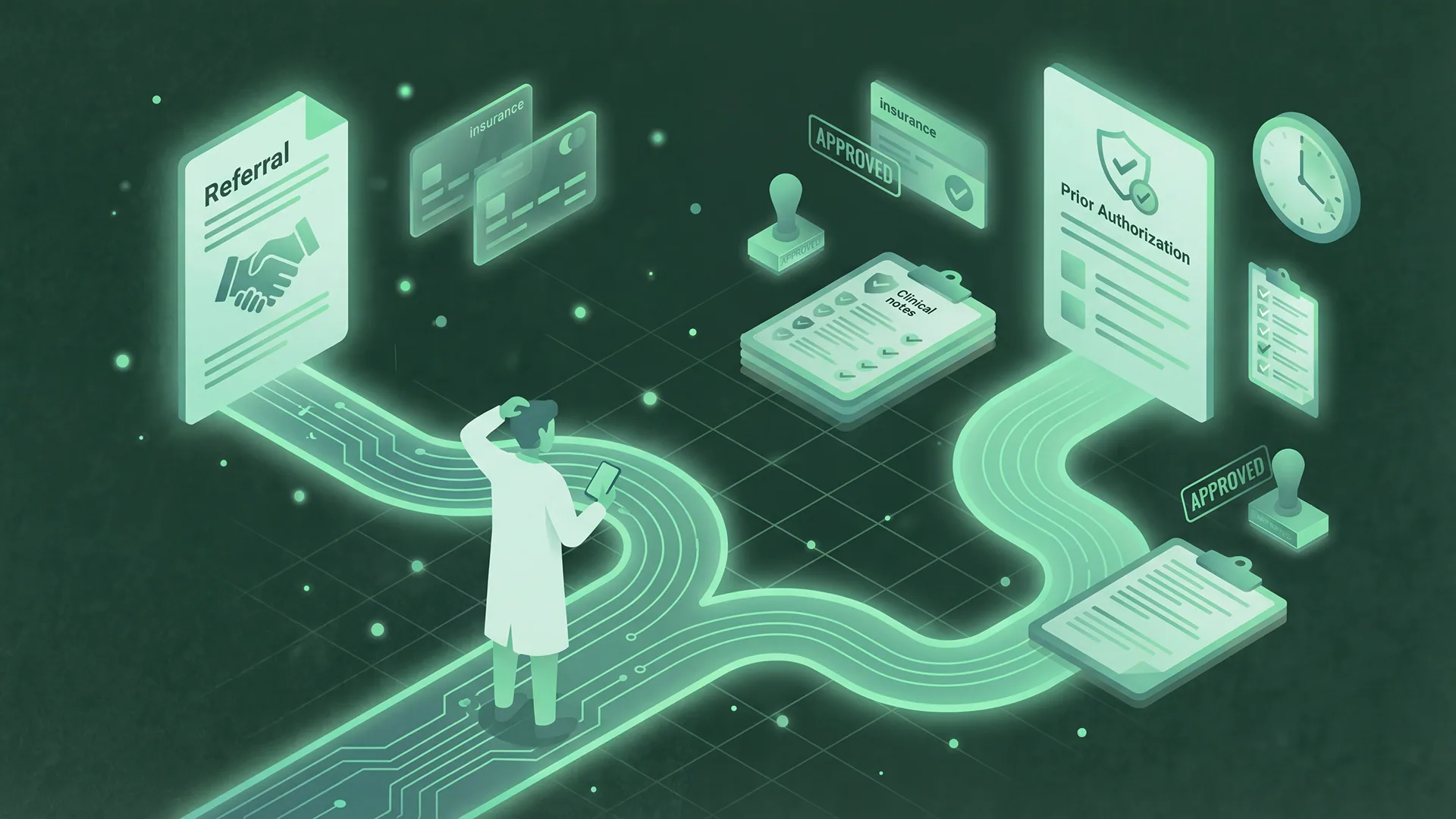
Industry data shows 25 to 40% of referrals are never completed, and they break at predictable handoff points rather than randomly: detection, scheduling, patient outreach, prior authorization, visit confirmation, and consult-note return.
This connects to care gap closure and what are care gaps in healthcare, plus value-based care referral coordination.
Why would a primary care group compare Aledade and Linear Health?
Primary care groups live at the intersection of quality, cost, access, and staffing.
They need to close care gaps. They need to complete referrals. They need to manage prior authorization. They need to reduce leakage. They need to keep patients moving through the next step in care.
Those needs make both value-based care partners and operational automation vendors relevant.
Aledade publicly describes itself as a physician-led value-based care company that partners with independent primary care practices, health centers, and clinics. Its category is about helping practices succeed in value-based care.
Linear Health's category is operational AI for healthcare. It automates administrative and coordination workflows that often determine whether value-based care goals are actually achieved.
The overlap is operational outcome, not product category.
What does Aledade help practices do?
Aledade helps primary care organizations participate in value-based care models and accountable care. Public Aledade materials emphasize independent primary care, ACO participation, population health, and value-based care performance.
That work can include analytics, contracting support, quality improvement, patient engagement strategy, and care model support.
For a primary care practice trying to move away from fee-for-service dependency, this can be strategically important. Aledade helps answer questions like:
- Which value-based care contracts should we enter?
- How do we succeed in accountable care?
- How do we identify risk and care opportunities?
- How do we support population health?
- How do we participate without losing independence?
Those are business model and care model questions.
What does Linear Health help practices automate?
Linear Health helps answer a different set of questions:
- How do we complete more outbound referrals?
- How do we stop coordinators from manually chasing every payer portal?
- How do we contact patients faster?
- How do we close care gaps with less staff burden?
- How do we reduce no-shows?
- How do we document closed loops in the EHR?
Those are operating model questions.
Linear Health automates work around referrals, prior authorization, scheduling, care-gap closure, AI voice, and patient engagement. It does not replace a value-based care partner. It helps the practice execute the work that value-based care requires.
That distinction matters. A practice can know exactly which patients need action and still fail if staff cannot reach, schedule, authorize, and document the work.
Where do value-based care strategy and operations meet?
Value-based care breaks down when insight does not become completed action.
For example:
- A care gap list identifies patients who need outreach.
- A referral report shows patients who never completed specialty care.
- A payer contract rewards completed annual wellness visits.
- A quality program depends on timely documentation.
In each case, strategy creates a list. Operations must close the loop.
That is where Linear Health's category matters. Operational AI does not decide clinical care. It automates the administrative steps required to make the next care step happen.
For primary care groups, the win is not simply more automation. The win is turning value-based care opportunity into completed outreach, scheduled visits, finished referrals, and documented closure.
Which work should be automated first?
Primary care groups should start with the work that creates the most leakage.
Common first workflows include:
- Outbound referral coordination
- Prior authorization for referred services
- Care-gap outreach and scheduling
- Annual wellness visit outreach
- AI voice for patient access
- No-show reduction workflows
The best first workflow has three traits:
- High volume
- Repetitive manual steps
- Clear outcome metric
For example, outbound referral completion can be measured by referral volume, completion rate, time to scheduled appointment, consult-note return, and staff touches per referral. Care-gap outreach can be measured by response rate, scheduled visit rate, completed visit rate, and documentation closure.
Can primary care groups use both?
Yes. In many cases, that is the most accurate answer.
Aledade can support value-based care strategy, contracting, analytics, and accountable care performance. Linear Health can automate the operational work that helps close the gaps those strategies reveal.
The two categories are complementary when used correctly.
The risk is category confusion. If a practice expects a value-based care partner to remove every manual workflow burden, it may be disappointed. If it expects an operational AI vendor to negotiate or manage value-based care contracts, it is asking the wrong product.
Linear Health has transformed how we manage referrals across our network. We're closing care gaps faster and our coordinators can finally keep up with demand.
Bottom line
Aledade and Linear Health are not interchangeable.
Aledade helps primary care organizations succeed in value-based care. Linear Health automates the operational workflows that help patients complete the next step in care.
If your question is how do we participate in value-based care, evaluate Aledade and similar partners. If your question is how do we complete referrals, authorizations, scheduling, and care gaps without adding more staff, evaluate Linear Health.
Primary care needs both strategy and execution. Know which one you are buying.
How do Aledade and Linear Health compare?
| Dimension | Aledade | Linear Health |
|---|---|---|
| Primary focus | Value-based care enablement and ACO participation | Operational AI for referral coordination, prior auth, scheduling, care gaps |
| EHR posture | Varies | Reads and writes inside athenahealth and any EHR |
| Prior authorization | Varies by module | Requirement checks, packet prep, status, denial routing |
| Closed-loop referral | Partial | Both inbound and outbound loops closed in the EHR |
| Time to live | Varies | Typically about four weeks |
| Pricing frame | Platform / seat | Priced against the team doing the work today |
Sources: Aledade homepage, plus published Aledade value-based care materials.
Frequently asked questions
Is Aledade a Linear Health competitor?
Can a primary care group use both?
Which should a practice evaluate first?
Which workflows should a primary care group automate first?
Do Aledade and Linear Health overlap?