


All Articles
Conversational AIHealthcare AIAutomation

AI Voice Scheduling Only Works When It Connects to the EHR

The question is not whether voice AI can handle calls after hours. The question is whether it can see your open slots and place a confirmed booking directly into your scheduling system.

LHT
Linear Health Team
Content Team, Linear Health

Loading audio...

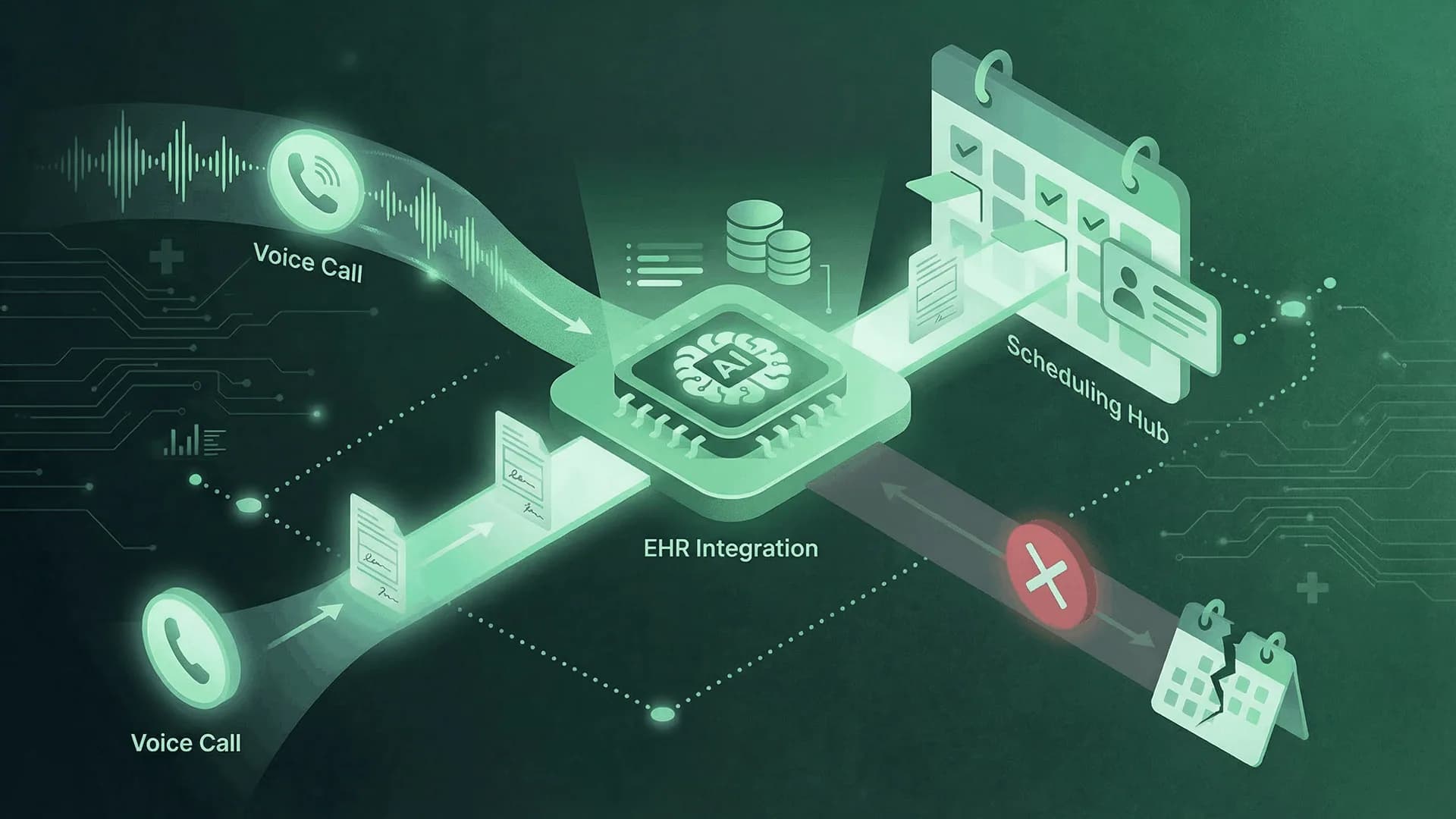
AI Voice Scheduling and EHR Integration - showing bi-directional data flow between voice AI and scheduling systems
Featured Image: AI Voice Scheduling and EHR Integration

Most practices evaluating AI voice technology are asking the wrong first question. The question is not "can this system handle calls after hours?" Almost any modern voice AI can do that. The question worth asking is: when a patient calls to book an appointment at 9 PM on a Tuesday, can the system see your open slots and place a confirmed booking directly into your scheduling system?

That distinction separates a voice-enabled answering service from a genuine scheduling infrastructure upgrade. And for practice operations leaders managing access metrics, template utilization, and front-desk workload, the difference is everything.

Gartner forecasts that 80% of healthcare providers will invest in conversational AI technologies by 2026, with EHR interoperability becoming a central buying criterion. The investment momentum is real. But the operational payoff depends entirely on integration depth, not on whether the voice sounds natural or the demo looks impressive.

Here is what separates the two categories:

Generic Voice BotEHR-Integrated Agent
Answers calls 24/7YesYes
Reads live provider availabilityNoYes
Books directly into scheduling systemNoYes
Handles rescheduling and cancellationsNoYes
Confirms appointment in real timeNoYes
Requires staff follow-up to completeYesNo

A system that can answer calls but cannot transact inside the schedule creates a new problem: patient interest that requires manual follow-through to convert. That is not automation. It is a more expensive voicemail.

Why Does After-Hours Access Matter More Than Most Scheduling Teams Realize?

After-hours scheduling demand is not a niche use case. A meaningful portion of patient scheduling intent happens outside staffed hours, and when practices rely on voicemail or callback queues to handle it, the result is not a delayed booking. It is often a lost one.

The three operational consequences of after-hours access gaps:

1. Capacity leakage. Patients who cannot book when they call frequently do not call back. They find another provider, use an urgent care alternative, or simply delay care. For specialty practices, this means unfilled slots that staff never knew were at risk. For primary care groups, it means attributed patients seeking access elsewhere, which affects utilization metrics and value-based contract performance.

2. Staff workload compression. Every voicemail that requires a callback, every missed call that needs a return, and every message that needs to be converted into a scheduled appointment lands on the front desk the next morning. That queue does not scale with volume. The administrative cost of clinician exhaustion in the U.S. reached an estimated $4.6 billion annually according to the American Medical Association, reinforcing that reducing repetitive administrative load is not a quality-of-life issue. It is a financial one.

3. Access metric pressure. For practices operating under value-based contracts or CMS quality programs, third-next-available appointment windows and patient access scores are tracked. Gaps in after-hours coverage inflate those windows and make it harder to demonstrate timely access.

The real issue is not that staff are unavailable after 5 PM. It is that the scheduling workflow stops when they leave.

An EHR-integrated voice agent does not just answer calls after hours. It keeps the scheduling workflow running continuously, with no manual handoff required the next morning.

What Does Real-Time EHR and Scheduling Integration Look Like?

The phrase "EHR integration" appears in nearly every healthcare AI vendor pitch. It rarely means the same thing twice. For operations leaders evaluating platforms, the distinction that matters is not whether a system connects to the EHR at all. It is what the system can read from it, what it can write back to it, and whether those transactions happen in real time.

How Does Superficial Integration Differ from Bi-Directional?

Most voice AI tools offer some form of EHR connectivity. The gap is in what that connectivity enables at the point of a patient interaction.

CapabilitySuperficial IntegrationBi-Directional Real-Time
Reads provider availabilityCached or delayedLive, at time of call
Applies scheduling rulesStatic templatesDynamic, per provider/location
Creates new appointmentsRequires staff actionAutomated, directly in PM/EHR
Handles reschedulingLogs request onlyUpdates record in real time
Confirms to patientPending staff reviewInstant confirmation during call
Syncs patient demographicsManual re-entryPulled from existing record
Sends reminders post-bookingSeparate manual workflowTriggered automatically

The infrastructure that makes this possible is increasingly standardized. 96% of U.S. hospitals have adopted HL7 FHIR APIs, the interoperability standard that enables real-time data exchange between external applications and core clinical systems. FHIR adoption means the technical foundation for deep scheduling integration exists across most environments. The question is whether the voice AI vendor has built to that standard or is routing around it with workarounds.

What Does the Data Layer Need to Handle?

For a voice agent to complete a scheduling transaction without staff involvement, it needs to access and act on several data points simultaneously:

  • Current provider availability across locations, appointment types, and time blocks
  • Patient identity and demographic record to match the caller to an existing chart
  • Insurance and eligibility context where applicable to routing rules
  • Appointment type logic to apply the correct visit duration, template slot, and provider match
  • Confirmation and reminder triggers to initiate post-booking patient communications

The voice AI market now includes vendors claiming compatibility with dozens of EHR platforms. But integration breadth is not the same as integration depth. A system that connects to many EHRs but can only read availability without writing back confirmed appointments still requires a human to close the loop.

The benchmark for operations leaders is simple: can the system complete a scheduling transaction, start to finish, without a staff member touching it?

Why Does Conversational Quality Matter Only After the Data Layer Works?

Conversational quality is a real differentiator. Patient communication research consistently shows that callers prefer a natural, human-like tone over rigid menu structures, and that IVR decision trees reduce task completion rates. Natural language understanding lets patients describe their needs the way they speak, without being forced through a phone system designed in 2009.

But here is the part most vendor pitches skip: a beautifully conversational voice agent that cannot transact inside the scheduling system is still an operational failure. The conversation ends. The booking does not happen. Staff still have to follow up.

Conversational quality should be evaluated second, after integration depth is confirmed. For a deeper comparison of these two categories, see how voice AI compares to traditional IVR in healthcare.

What Does a Complete Scheduling Interaction Look Like?

When the data layer works, a fully integrated voice agent can handle an end-to-end scheduling interaction in a single call:

  1. Patient calls after hours. The agent answers immediately, identifies the caller against the existing patient record, and confirms their name and date of birth.
  2. Patient states their need in natural language. "I need to see Dr. Chen for a follow-up, sometime next week in the afternoon." The agent interprets the request, queries live availability against the connected scheduling system, and offers specific confirmed options.
  3. Patient selects a slot. The agent books the appointment directly into the EHR, confirms the details verbally, and triggers an automated reminder sequence. No staff involvement. No callback queue. No morning follow-up required.

This workflow is only possible because the conversational layer has access to live scheduling data. Without that connection, step 2 ends with "I'll have someone call you back," which is not an AI scheduling solution. It is an AI-assisted message-taking service.

The practical implication for buyers: do not evaluate conversational quality in isolation. Demo the booking flow end-to-end, with a live scheduling system connected, before drawing any conclusions about operational value. Our buyer's guide for voice AI in healthcare walks through the full evaluation framework.

See EHR-integrated voice scheduling in action

Linear Health connects voice AI directly to your scheduling system for real-time appointment booking with no staff involvement.

Which Voice AI Platforms Offer Real EHR Scheduling Integration?

The market for healthcare voice AI has grown fast, with several well-funded vendors now offering scheduling capabilities. The differences come down to integration depth, specialty coverage, and what happens after the call ends.

VendorEHR IntegrationDirect BookingBest Fit
Assort HealthBi-directional with Epic, major EHRs. 99% scheduling accuracy claimed.YesLarge specialty groups and health systems
Luma HealthBi-directional with Epic, Oracle, MEDITECH, athenahealth, eCW, NextGenYesEnterprise health systems and large networks
Hello PatientEHR integration with major platformsWith staff handoff for complex casesEnterprise high-volume call handling
Linear HealthBi-directional with athenahealth, Epic, Cerner. 4-week go-live.Yes, no staff handoffMid-market specialty (5-50 providers), FQHCs, PE-backed groups

Three things matter in this comparison.

First, Assort Health and Luma Health are the strongest pure voice AI competitors for large organizations. Assort has raised $102M and handles millions of calls annually for thousands of providers. Their 99% scheduling accuracy and specialty-specific AI training are production-proven at scale. Luma serves 600+ health systems with a broader patient success platform that includes fax automation and waitlist management alongside voice.

Second, the market has split between platforms that solve the phone call (Assort, Hello Patient) and platforms that connect the phone call to everything that happens before and after it (Luma, Linear Health). For practices where scheduling is the primary bottleneck, a dedicated voice AI platform may be sufficient. For practices where the referral pipeline, prior authorization delays, and patient outreach gaps are all contributing to unfilled slots, the phone call is only one piece of the problem.

Third, Linear Health's differentiation is the connected workflow. When a referral arrives by fax, the system extracts the data, creates the chart, submits the prior authorization, contacts the patient, and books the appointment. The voice AI layer sits inside that pipeline, not beside it. That connection is what makes it possible for a scheduling interaction to happen the same day a referral arrives, rather than days or weeks later.

"Every time we used the scheduling automation, bookings went up and staff could focus on patient care instead of phone tag."

— Anuradha Jairam, Director of Operations, Vancouver Sleep Center

What Outcomes Should Operations Leaders Measure?

The business case for EHR-integrated voice scheduling is not speculative. The outcomes that matter to practice operations leaders are measurable, and the evidence on each is specific.

No-show reduction. Conversational AI reminders reduce no-show rates by 30 to 40%, compared with 10 to 15% for traditional reminder approaches, according to findings from Northwell Health. The difference is not just channel preference. It is that a voice agent can confirm, reschedule, or collect cancellation intent in a single interaction, rather than sending a one-way message that patients ignore. For more on evidence-based no-show strategies, see how specialty clinics reduce no-show rates.

Administrative task reduction. AI voice agents handling scheduling, rescheduling, and reminder workflows can reduce front-desk administrative load by up to 70% in documented deployments. That is not a projection. It reflects what happens when repetitive inbound call volume is handled without staff intervention.

Schedule utilization. Canceled slots are among the hardest access problems to solve manually. AI-driven waitlist matching can fill 60 to 80% of canceled slots within hours, compared with 20 to 30% fill rates through manual outreach. A peer-reviewed study from UCSF published in JAMIA found that automated waitlist processes moved over a million appointment offers in a single calendar year, with patients successfully self-rescheduling to earlier slots without staff involvement. For practices with high cancellation rates, this is a direct revenue recovery mechanism.

OutcomeTraditional ApproachAI Voice + EHR
No-show reduction10-15%30-40%
Admin task reductionBaselineUp to 70%
Canceled slot fill rate20-30%60-80%
After-hours booking0% (voicemail)Continuous

The Linear Health patient engagement platform is built around these outcomes, connecting voice AI, automated outreach, and scheduling workflows to the EHR rather than layering on top of it.

The operational case is not about replacing staff. It is about ensuring that the scheduling workflow does not stop when staff do, and that every patient interaction that reaches the practice has a path to a confirmed appointment rather than a callback queue.

Who Is EHR-Integrated Voice Scheduling Best For (and Who Should Wait)?

Best fit:

  • Mid-market specialty practices (5-50 providers) with high inbound call volume and after-hours scheduling demand
  • Multi-location groups and PE-backed clinic organizations standardizing scheduling across sites
  • FQHCs managing access metrics, UDS reporting, and Medicaid MCO scheduling complexity
  • Practices already running athenahealth, Epic, or Cerner where bi-directional API integration is production-ready

Less ideal fit (for now):

  • Solo practices or very small groups with fewer than 10 inbound scheduling calls per day, where the ROI timeline is longer
  • Practices on legacy or niche EHR platforms where bi-directional API integration is not yet available, as workarounds may introduce manual steps
  • Organizations whose primary bottleneck is referral intake or prior authorization rather than scheduling, where solving the upstream problem first may deliver faster returns. See voice AI use cases across healthcare to identify where the highest-leverage intervention sits for your practice.

What Should You Ask Before Choosing a Voice AI Scheduling Platform?

The market for healthcare AI voice tools is growing fast, but growth does not guarantee implementation success. Gartner has cautioned that over 40% of agentic AI projects will be canceled before the end of 2027, typically due to integration failures, unclear workflow scope, and the gap between demo performance and live deployment reality.

For practice operations leaders, the evaluation framework should be anchored in workflow execution, not conversational capability. Use this checklist before committing to any platform:

Integration and Workflow Coverage:

  • Can the system read live provider availability from your scheduling system at the time of the call, not from a cached or synced copy?
  • Can it write confirmed appointments directly back to your EHR or practice management system without staff intervention?
  • Does it handle rescheduling and cancellations in real time, not just log the request for follow-up?
  • Does it support your specific scheduling rules: appointment types, provider-location logic, new vs. established patient routing, and insurance-based restrictions?
  • Can it escalate appropriately when a request falls outside its scope, without dropping the patient interaction?

Operational and Security Validation:

  • What EHR platforms does the system have production deployments on, not just claimed compatibility?
  • What is the implementation timeline and scope, and what does your team need to configure or maintain?
  • How does the system handle HIPAA compliance, data residency, and PHI in voice interactions? (See our HIPAA compliance guide for voice AI for the full checklist.)
  • Can the vendor provide real deployment examples showing access or utilization improvement, not just pilot results?
  • What happens to calls the agent cannot complete? Is there a defined escalation path, or do they fall into a void?

Integration depth and standardization have become critical benchmarks in healthcare AI evaluation. A system that scores well on conversational quality but cannot answer these workflow questions is not ready for production scheduling operations.

The Linear Health scheduling automation platform is built to answer yes to every question above, with bi-directional EHR integration, real-time availability access, and deployment experience across specialty practices, FQHCs, and multi-site groups.

From Call Handling to Access Infrastructure

The category is shifting. AI voice in healthcare is moving from answering service replacement to scheduling infrastructure, and the practices that benefit most are those that treat it as an operational system rather than a front-desk add-on.

The evidence is consistent: EHR-integrated voice agents reduce no-shows by 30 to 40%, cut administrative task volume by up to 70%, and keep the scheduling workflow running continuously rather than only during staffed hours. With 96% of hospitals now operating on FHIR-compatible infrastructure, the integration foundation is in place. The remaining variable is whether the vendor has built to it properly.

For practice operations leaders, the decision framework is straightforward:

  • Does the system complete scheduling transactions in real time, or does it create work for staff to finish?
  • Does it connect to your live scheduling data, or does it route calls and hand off to humans?
  • Can it demonstrate outcomes in production deployments, not just controlled demos?

If the answer to any of those is unclear, the integration is not ready for your scheduling workflow.

The Linear Health voice AI platform is designed around this standard: bi-directional EHR integration that reads live availability, writes confirmed appointments, and closes the scheduling loop without manual follow-through. For practices managing access, utilization, and front-desk capacity simultaneously, that is the difference between a voice tool and a scheduling system that works.

Book a demo with Linear Health. See how EHR-integrated voice scheduling works in a live environment with your scheduling system connected.

Frequently Asked Questions

Does voice AI integrate with EHR systems for real-time scheduling?

Leading voice AI platforms integrate bi-directionally with EHR and practice management systems including athenahealth, Epic, and Cerner. Bi-directional means the system reads live provider availability and writes confirmed appointments back to the scheduling system in real time, with no staff involvement required. The key distinction is between vendors that offer cached or delayed availability versus those that pull live data at the moment of the patient call.

What is the difference between a voice bot and an EHR-integrated scheduling agent?

A generic voice bot answers calls and captures patient requests, but requires staff to complete the booking manually. An EHR-integrated scheduling agent reads live provider availability, applies scheduling rules, books directly into the practice management system, confirms the appointment with the patient during the call, and triggers automated reminders. The difference is whether the system completes the transaction or creates work for staff to finish.

How much do no-show rates improve with AI voice scheduling?

Conversational AI reminders reduce no-show rates by 30 to 40%, compared with 10 to 15% for traditional one-way reminder approaches. The improvement comes from the ability to confirm, reschedule, or collect cancellation intent in a single interaction rather than sending a message that patients ignore.

How long does it take to implement voice AI scheduling with EHR integration?

Implementation timelines vary by vendor and EHR platform. Linear Health goes live in 4 weeks with bi-directional EHR integration, scheduling rule configuration, and staff training included. The EHR remains the system of record throughout. Most practices see measurable impact within the first two weeks of deployment.

Is voice AI HIPAA compliant for patient scheduling calls?

Voice AI can be HIPAA compliant when the vendor signs a Business Associate Agreement, encrypts all call data and appointment information, applies role-based access controls, and maintains audit logs of every patient interaction. Practices should verify how the vendor handles call recordings, transcript storage, and data retention before deployment. SOC 2 Type II certification provides additional verification that security controls are tested and maintained. For a full walkthrough, see our HIPAA compliance guide for voice AI in healthcare.

AI voice schedulingEHR integrationhealthcare scheduling automationvoice AI healthcareafter-hours patient schedulingbi-directional EHRFHIR API
Sami Malik
Sami Malik
Founder & CEO, Linear Health

Sami scaled Simple Online Healthcare to $150M and built a multi-specialty telehealth clinic across 20 specialties and all 50 states. Connect on LinkedIn.

Share this article

Automate your referral workflows

See how Linear Health goes from fax to booked appointment in minutes.

Book a Demo

Stay updated

Healthcare AI insights, monthly.

Key Numbers

80-120
Referrals processed daily per coordinator
14 hrs
Spent weekly on prior authorization
25%+
Annual admin staff turnover
2.7x
Average outreach attempts per referral

Related Articles

Automate your referral workflows

Stay updated

Get the latest on AI healthcare coordination.

AI Voice Scheduling and EHR Integration: What Works (2026)