



What Is AI-Powered Referral Automation?
AI-powered referral automation is the approach that fixes referral leakage structurally, not by hiring more coordinators to run the same process faster, but by replacing the manual steps themselves with AI agents that run continuously, in parallel, across every referral in the queue.

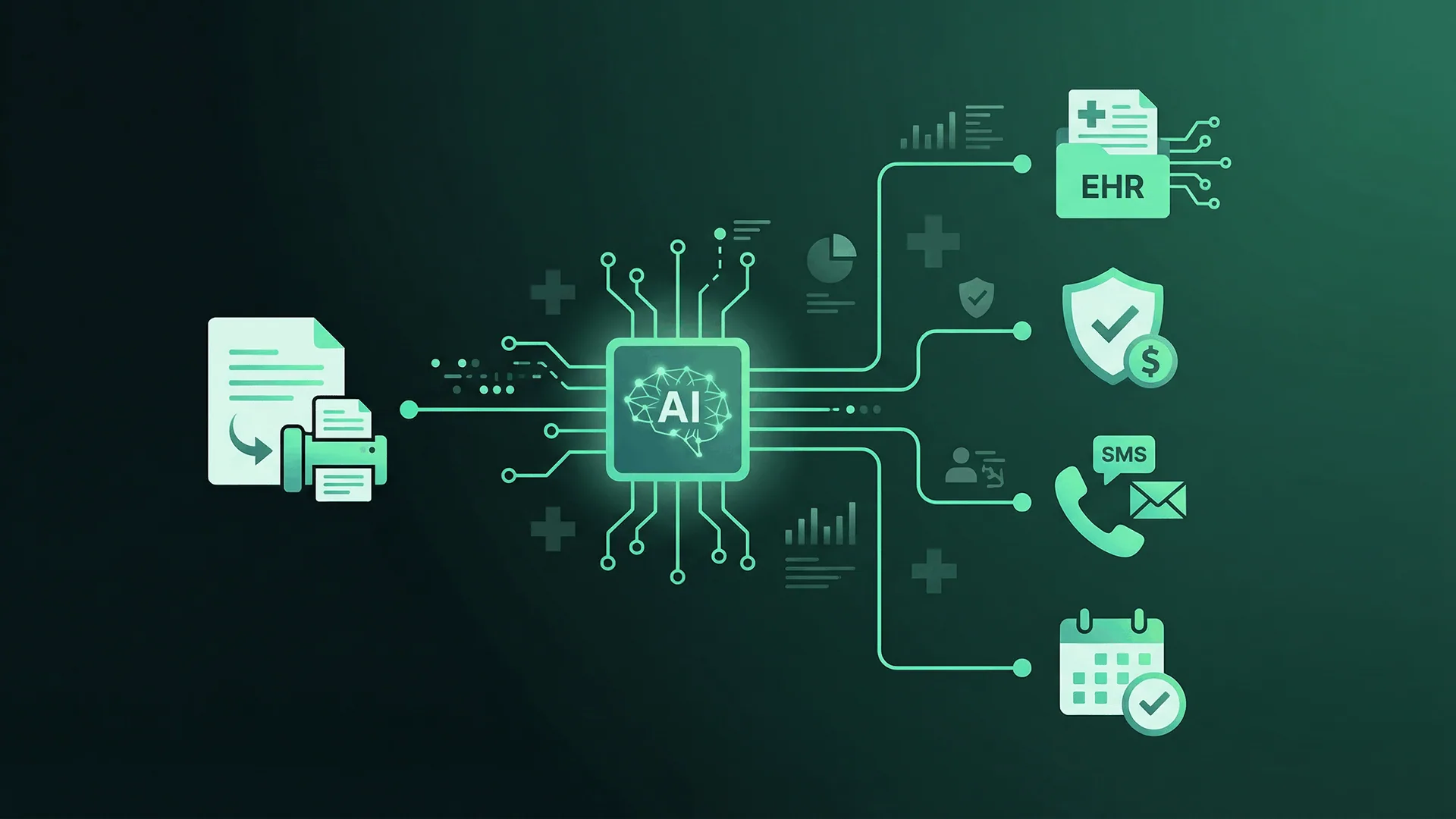
There is a version of a referral workflow that most people in healthcare operations know by heart. A fax arrives. Someone reads it. They type the patient's information into the EHR by hand. They call the patient. The patient does not answer. They call again. They try to schedule something. They hope prior authorization goes through. They send the referral out to the specialist, note it in a tracker somewhere, and move on to the next one in the pile.
It works. It worked well enough for a long time.
The problem is the pile. Referral volumes have grown faster than the administrative infrastructure designed to handle them. The same process that was manageable at 20 referrals a day starts to buckle at 80. And when it buckles, the losses are quiet: patients who never get scheduled, authorizations that expire before anyone submits them, consult notes that never make it back, revenue that never gets captured. Industry research consistently puts this loss rate, known as referral leakage, at 20 to 30 percent of all referrals at practices running on manual workflows.
AI-powered referral automation is the approach that fixes this structurally, not by hiring more coordinators to run the same process faster, but by replacing the manual steps themselves with AI agents that run continuously, in parallel, across every referral in the queue.
What It Actually Does
The simplest way to explain it: AI-powered referral automation handles the coordination tasks between a referral arriving and a patient being seen, without a staff member initiating each step.
On the inbound side, that means reading incoming referrals (including handwritten faxes), extracting the relevant clinical and demographic information, creating the patient chart in the EHR, verifying insurance in real time, checking the patient is in-network, submitting prior authorization requests where required, reaching out to the patient in their preferred language by SMS, email, or voice call, and booking the appointment based on patient preference and specialist availability.
On the outbound side, it means tracking the referrals your practice sends out: confirming the receiving specialist got them, verifying the patient's insurance and any plan-specific requirements like Medicaid quotas, following up with the specialist's office if there is no response, tracking whether the patient was actually seen, chasing the consult note if it has not come back, and routing that note back into the patient's record in the EHR automatically when it arrives.
In a well-built system, AI agents handle all of this in parallel. Hundreds of referrals in various stages of the workflow move forward simultaneously, flagging anything that needs human attention while everything with a clear path moves through on its own.
What It Replaces
Understanding what AI referral automation replaces is as important as understanding what it does.
It replaces the manual triage of incoming faxes. Instead of a coordinator reading each document, identifying what it is, and routing it to the right place, the AI reads it, classifies it, extracts the structured data, and acts on it.
It replaces the manual insurance verification phone call. The AI queries payer systems in real time, confirms coverage, and flags any prior authorization requirements before the appointment is booked.
It replaces the patient outreach loop. No more leaving voicemails, waiting for callbacks, and calling again the next day. The AI sends coordinated multilingual outreach across multiple channels and escalates to a voice call if earlier touchpoints go unanswered.
It replaces the referral tracking spreadsheet. The full status of every inbound and outbound referral is tracked automatically, with alerts for anything stalling.
It replaces the consult note chase. If a note has not come back within the expected window, the AI follows up with the specialist's office directly, without anyone on your team needing to remember to do it.
What it does not replace is clinical judgment, care decisions, or the conversations between providers and patients that need a human. The goal is not to remove your staff from the referral process. It is to remove the administrative coordination burden so they can be present for the parts that genuinely need them.
Why Practices Are Moving to This Now
The adoption curve for AI referral automation has accelerated for a few reasons that, taken together, have changed the calculation for most practice operators.
Referral volumes have outgrown manual capacity. Specialty practices in growth mode, FQHC networks expanding to new sites, PE-backed clinic groups consolidating operations: all of them are handling more referrals per coordinator than was true five years ago. At some point the math stops working.
Payer environments have gotten more complex. Prior authorization requirements have expanded significantly. The administrative burden of managing authorizations manually (tracking their status, resubmitting denials, and appealing incorrectly denied claims) has grown alongside it. Automating the submission layer is no longer optional for high-volume practices that want those claims to go through on time.
Deployment on top of the existing EHR has become real. Earlier generations of referral management software required you to be on a specific EHR or to build an integration that took months. Modern AI referral automation platforms run on top of your existing EHR rather than replacing it, typically taking the first workflow live in around four weeks, without a migration or parallel workflow.
The ROI is straightforward to model. Take your referral volume. Multiply by your estimated leakage rate. Multiply by your net revenue per completed visit. That is the floor of the opportunity. Every proposal shows your return against your own numbers. We build to 3x or better. The return is driven by improved completion rates and the recovery of staff capacity that was previously consumed by manual coordination.
The Two Sides Most People Miss
When people think about referral automation, they tend to think about inbound: getting the referral in, processing it, booking the patient. That is the most visible bottleneck, so it gets the most attention.
Outbound is where most practices have the least visibility and, often, the most to gain.
Every referral you send out is a patient care obligation. If the specialist does not receive it, if the patient is not contacted, if the consult note does not come back, the clinical and administrative loop is open. In value-based care models, open loops have real consequences: care gaps that affect quality scores, HEDIS measures that go unmet, MCO incentive payments that depend on documented coordination.
A complete AI referral automation system closes both sides of the loop. Inbound gets processed, authorized, and scheduled. Outbound gets tracked, chased, confirmed, and documented. The multi-agent architecture that makes this possible runs continuously in the background, surfacing exceptions and completing the steps that used to fall through the cracks.
What to Look For When You Evaluate
Not every platform calling itself AI referral automation covers the full workflow. A few things to look for specifically:
Both inbound and outbound coverage. Ask what happens after you send a referral out. Many platforms focus heavily on inbound and treat outbound as a reporting feature rather than an active coordination layer.
A real integration with your EHR. Ask to see the integration running live in your actual system. Platforms with genuine native integrations will do this without hesitation.
Prior authorization automation, not just support. The distinction is meaningful. Supporting prior auth means a human still initiates the submission. Automating it means the AI does. Ask for the specific percentage of authorizations that go through without staff initiation.
Multilingual patient outreach. For FQHCs and practices serving diverse populations, outreach only in English is not sufficient. Ask about language support across SMS, email, and voice channels.
A go-live timeline that fits your operation. Implementation times vary widely. Four weeks is achievable with a platform that has an established integration for your EHR. Anything requiring a full integration build or data migration will take significantly longer.
Frequently Asked Questions
Is AI referral automation the same as referral management software?
Does it work with our EHR?
What happens to our referral coordinators?
How do we know if we have a referral leakage problem worth addressing?
How long does implementation take?
Related Reading