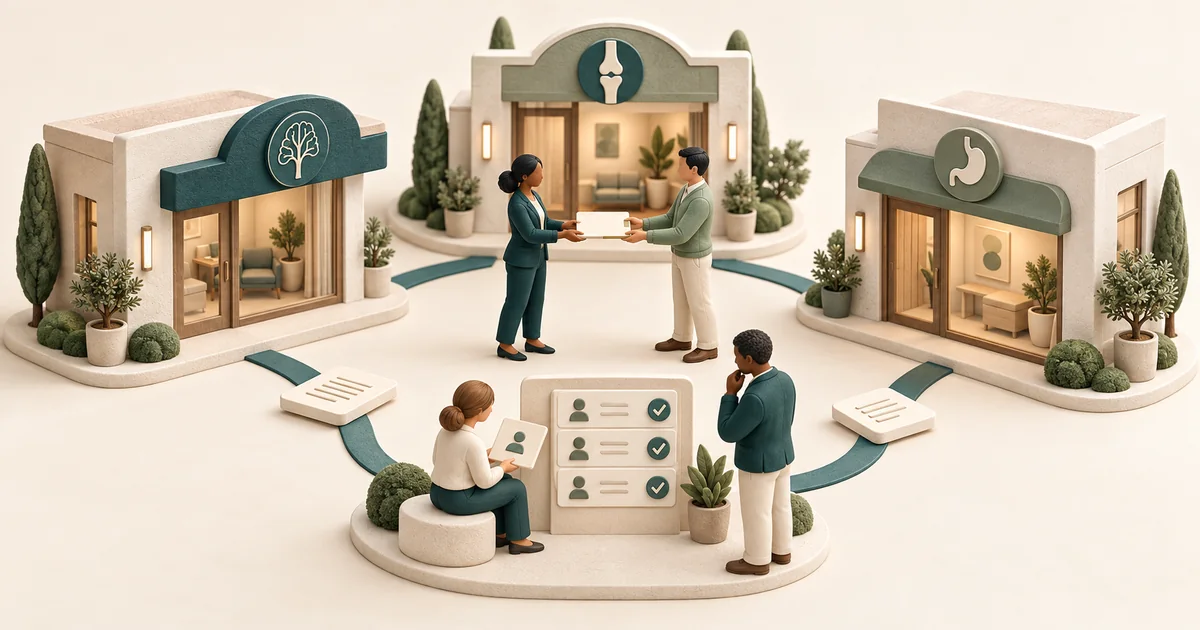



Telehealth referral coordination, from virtual visit to local follow-up.
When a virtual encounter ends with a downstream need, an in-person specialist, imaging, a procedure, Linear Health turns that order into a coordinated handoff: records packaged, the patient's preference applied first, eligibility verified, outreach and scheduling run to completion, and the status returned to your clinical workflow. Decisions the system should not make stay with your staff at a visible validation area.
How does referral coordination work after a virtual visit?
The order becomes an operational follow-up packet: records, preference, and coverage assembled automatically. Staff-validated constraints shape where it can go, outreach and scheduling run to a booked local visit, and the confirmed result returns to the workflow the clinician already uses.
Encounter completes, packet forms
The downstream order becomes a follow-up packet, reason, records, preference, and coverage, assembled without re-keying, using the same engine as outbound referral coordination.
Your team validates the constraints
Network participation, geography, licensure context, and payer-policy questions are your team's decisions. Linear assembles the inputs, applies the constraints your staff have validated, and pauses for a person wherever a decision is not the system's to make. Approved rules become reusable; anything novel routes to a named owner.
The patient is reached and booked
Outreach runs by text, email, and voice AI in English and Spanish, with first contact in about 5 minutes, and scheduling books against the receiving provider's real availability with reminders that protect the slot.
Tracked, retrieved, returned
The referral is followed to the visit, the result is pursued, and the status lands back in your source workflow, closing the loop the clinician opened on camera.
Where the handoff is the bottleneck.
The loop earns its keep in virtual-first organizations whose encounters routinely end in orders for imaging, labs, procedures, or in-person specialty care, in hybrid groups moving patients between virtual visits and their own or partner clinics, in virtual specialty services that depend on local diagnostics completing before the care plan can move, and in teams staffing the follow-up queue by hand today.
Not the right fit: pure virtual services with no downstream coordination need, or organizations looking for a telehealth delivery platform. Linear does not host visits; it coordinates what they set in motion.
A proven coordination engine, scoped for virtual care.
The engine behind this page runs at scale for published, named customers in adjacent segments.
A 35-site Federally Qualified Health Center running 10,000+ referrals and coordination events per month through the same loop. Read the case study.
A specialty practice that consolidated five coordination tools into one and took a 37% missed-call rate to near zero. Read the case study.
A telehealth-specific case study is not yet available; virtual-care organizations typically start with a scoped pilot on their real handoff workflow and a direct introduction to a current customer.
The mechanics behind the handoff.
Frequently asked questions
Direct answers for virtual-care operators, including the boundary questions compliance will ask.
How are referrals coordinated after a virtual visit?
When a virtual encounter ends with a downstream need, an in-person specialist visit, imaging, a lab draw, a local procedure, Linear turns the order into an operational follow-up packet: records attached, patient preference captured first, eligibility verified, then outreach, scheduling, and status tracking until the result returns to your source workflow. Staff validate any constraint the system should not decide.
Who decides network, licensure, and state-rule questions?
Your people. Cross-state practice requirements vary and are your compliance team's domain; network participation and payer-policy questions belong to the owners you designate. Linear's role is workflow support: it assembles the inputs, applies the constraints your staff have validated, and pauses for a person wherever a decision is not the system's to make.
How does local follow-up actually get scheduled?
The same way Linear schedules everything else: patient outreach by text, email, and voice in English and Spanish, booking against the receiving provider's availability, reminders that protect the slot, and re-engagement when plans change. First patient contact happens in about 5 minutes from the handoff, compared with the 3-7 days a manual queue takes.
How do results return to our clinical workflow?
Linear follows the referral to the visit, confirms it happened, pursues the resulting note or report, and returns the status to your source system, so the clinician who saw the patient virtually can see what happened next without chasing a fax.
Which systems does Linear work with?
Linear runs on top of your existing clinical stack. athenahealth, eClinicalWorks, NextGen, Greenway Health, Veradigm, and Epic are established integrations, connected through standard health-data interfaces. Compatibility with your specific virtual-care platform is confirmed during scoping rather than claimed universally.
Do you have telehealth customers we can reference?
Linear Health's published case studies are Aunt Martha's Health & Wellness, an FQHC, and Texas Sleep Medicine, a specialty practice; both run the same coordination engine this page describes. A telehealth-specific case study is not yet available, so virtual-care organizations typically start with a scoped pilot and a direct introduction to a current customer.
What does it cost, and how long to go live?
Pricing is $1,000-$8,000/mo, usage-based, month-to-month. Go-live is 4 weeks, and our customers typically see a 3:1 return within 90 days, measured against their own baseline.
Bring one post-visit order. Watch the status come back.
The working demo runs a real handoff: your workflow, your constraints, your staff validation. Go-live is 4 weeks, pricing is $1,000-$8,000/mo, usage-based, month-to-month, and customers typically see a 3:1 return within 90 days.