



AI phone agents vs medical answering services: cost, coverage, and what patients experience
A traditional medical answering service takes messages for a per-call or per-minute fee; staff still return every call. An AI phone agent answers 24/7, verifies callers, books directly into the EHR, and escalates urgent calls to humans. The right choice depends on call volume, scheduling needs, and budget.

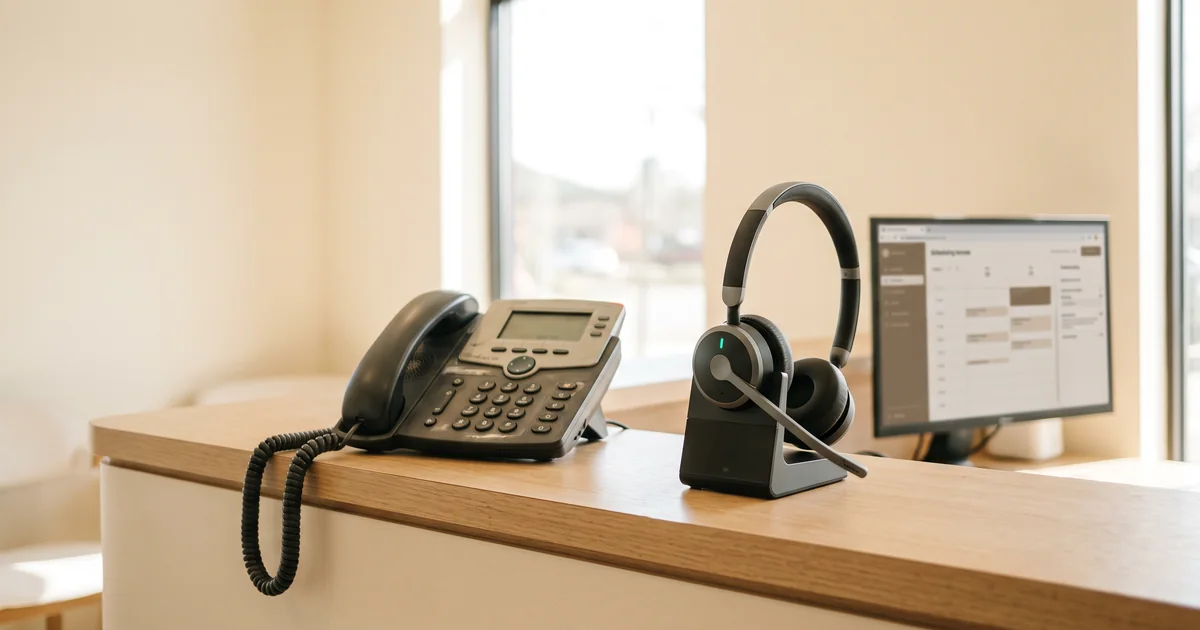
Most medical practices bought an answering service years ago to solve one problem: the phone should not ring into nothing when the office is closed. The service answers with the practice's name, takes a message, pages the on-call provider for urgent issues, and faxes or emails the rest for the morning. That model has barely changed in decades.
What has changed is what is possible. AI phone agents now hold natural conversations, verify who is calling, check real appointment availability, book directly into the practice management system, and hand off to a human when the call needs one. The comparison is no longer "answering service vs missed calls." It is "message-taking vs call resolution," and the two models produce very different economics and patient experiences.
This article compares the two options as a buying decision: what each one does, what each costs, what patients experience, and when the traditional service is still the right call.
What a traditional answering service does
A medical answering service is a staffed call center (or a small local operator room) that answers your line when you do not. The core workflow is message-taking: the operator answers with your greeting, follows a script to collect the caller's name, callback number, and reason for calling, and routes the result. Urgent calls trigger a page or a warm transfer to the on-call clinician; everything else lands in a message queue for the morning.
What the service generally does not do is resolve the call. Operators do not have access to your EHR or schedule, so they cannot book, reschedule, or cancel appointments, cannot answer questions about a specific patient's care, and cannot verify insurance. The caller who wanted an appointment gets "someone will call you back," and your front desk inherits a callback list on top of the morning's inbound volume.
Pricing is usually per call, per minute, or per message unit, often with a base fee. That structure is workable at low volume and punishing at high volume: every marketing campaign, seasonal surge, or phone tree failure shows up directly on the invoice. Practices comparing options should also confirm the service will sign a business associate agreement, since operators routinely handle protected health information; the HIPAA rules for that relationship are set by HHS.
What an AI phone agent does
An AI phone agent is software that answers the phone and completes the call. Instead of an operator with a message pad, the caller gets a conversational agent that can verify identity, look up real availability, schedule or reschedule the appointment, answer routine questions about hours, locations, and preparation instructions, collect intake details, and write the outcome back to the EHR. When the call is urgent, emotional, or simply outside what the agent handles, it escalates to a human: a warm transfer during business hours, or on-call paging after hours.
The distinctions from older phone technology matter here. This is not an IVR menu ("press 2 for scheduling") and not a rigid chatbot; the caller speaks normally and the agent handles the request directly. For a deeper technical comparison of those tiers, see voicebots vs IVR vs live agents in healthcare.
Coverage is the other structural difference. An AI agent answers every call simultaneously: there is no hold queue at 8:01 am and no voicemail at 5:31 pm. It works the same at 2 pm and 2 am, in multiple languages, on holidays. Compliance is achievable but must be verified: the vendor should sign a BAA and demonstrate the safeguards covered in our guide to HIPAA-compliant voice AI.
The proof point worth studying is Texas Sleep Medicine. Before automation, 37% of the practice's inbound calls were being missed. After deploying an AI voice agent, missed calls fell to approximately ~0%, and the system was live in 4 weeks.
Side-by-side comparison
| Dimension | Traditional answering service | AI phone agent |
|---|---|---|
| Cost model | Per call, per minute, or per message, plus base fees; cost scales linearly with volume | Typically flat or usage-based subscription; cost flattens as volume grows |
| Coverage | After-hours and overflow, limited concurrent capacity, hold queues at peak | 24/7/365, answers every call concurrently, no hold queue |
| Scheduling capability | None; takes a message for staff to work later | Books, reschedules, and cancels against real availability |
| EHR/PMS integration | None; output is a message via fax, email, or portal | Reads availability and writes appointments and call outcomes back to the EHR |
| Escalation | Pages on-call for urgent calls per script | Warm transfer or on-call paging, with configurable urgency rules |
| Languages | Depends on staffing; bilingual operators cost extra | Multilingual by configuration |
| Compliance | BAA required; operator handling varies by vendor | BAA required; verify safeguards, logging, and data handling |
| Documentation | Free-text message, often retyped into the chart | Structured call record and transcript written back automatically |
| Patient experience | Human voice, but "we'll pass along the message" | Immediate resolution for routine calls, human handoff for the rest |
The cost math practices run
The invoice comparison misses the real economics. An answering service bill is only the first cost; the second is the staff time to return every message the next morning, and the third is the revenue that leaks while callers wait. A patient who calls to schedule and reaches message-taking has not scheduled. Some fraction will not answer the callback, and some will book with whoever answered the phone live.
That is why missed and unresolved calls are a revenue problem, not a telecom problem. In Texas Sleep Medicine's case, the 37% of calls going unanswered represented recoverable revenue once the calls were answered and converted into booked appointments. The full method for quantifying this for your own practice is covered in our guide to the ROI of voice AI in healthcare.
A simple way to structure the comparison for your own numbers:
- Count total inbound calls per month, including after-hours and abandoned calls (your phone system reports this).
- Price the answering service path: per-call fees, plus front-desk minutes per returned message, plus an estimated conversion loss on callbacks.
- Price the AI agent path: subscription cost, minus the staff time eliminated, plus the revenue from calls that convert immediately instead of entering a callback loop.
- Compare at your growth volume, not your current one. Linear per-call pricing gets worse as you grow; flat or usage-based pricing gets better.
What patients experience with each
With an answering service, the after-hours caller gets a human voice, which many patients find reassuring, followed by a message-taking script and a promise of a callback. The experience is polite but inconclusive: the patient hangs up without an appointment, without an answer, and without certainty about when the callback will come. For anxious callers, "someone will get back to you" can mean calling again in the morning, which doubles your inbound volume for the same request.
With an AI phone agent, the routine caller finishes the task on the first call: appointment booked, refill request routed, directions given, in the caller's preferred language, at any hour. The experience risk runs the other direction: some patients are wary of automated voices, and a poorly designed agent that traps callers or fails to hand off will do more brand damage than any answering service. The design bar is that reaching a human must always be easy, immediate, and obvious, and that the agent says clearly what it is.
Neither option should ever stand between a patient and emergency care. Both models must open with clear guidance that anyone experiencing a medical emergency should hang up and call 911, and both must route urgent clinical calls to the on-call clinician without delay.
When an answering service is still the right call
An honest comparison includes the cases where the traditional model wins:
- Very low call volume. A solo practice getting a handful of after-hours calls a week may not generate enough activity for automation to pay back; a per-call service is cheap at that scale.
- No scheduling need after hours. If nearly all after-hours calls are clinical triage that must reach the on-call provider anyway, message-taking plus paging already covers the job. The full menu of coverage models is compared in our guide to after-hours call handling.
- No integrable system. If the practice management system offers no API or integration path, the AI agent's biggest advantage (EHR write-back) is off the table until that changes.
- Zero appetite for change management. An answering service requires almost no setup. An AI agent requires configuring call flows, escalation rules, and integration, a matter of weeks, but not zero effort.
- A patient population that strongly prefers humans. Some practices serve populations where an automated voice, however capable, will suppress call completion. Pilot before committing.
Many practices land on a hybrid: an AI agent answers first and resolves the routine majority, with a live service or on-call staff behind it for escalations. That pattern, and the broader automation architecture around it, is covered in our guide to healthcare call center automation.
The bottom line
An answering service sells coverage; an AI phone agent sells resolution. The service ensures a human voice answers and a message gets taken, but every message is deferred work for your staff and a deferred outcome for the patient. An AI agent completes the routine calls (scheduling above all) directly in the EHR, around the clock, and escalates the calls that need a human.
At low volume with no after-hours scheduling need, the answering service remains a perfectly rational purchase. At meaningful call volume, the math shifts: linear per-call pricing plus next-morning callback labor plus leaked bookings usually costs more than automation, before counting the patients who quietly booked elsewhere. Run the comparison on your own call counts, and weight the option that turns a missed call into a booked appointment.
Frequently asked questions
What is the difference between an AI phone agent and a medical answering service?
Can an AI phone agent schedule appointments?
Are AI answering services HIPAA compliant?
How much does a medical answering service cost compared to an AI agent?
Do patients accept talking to an AI on the phone?
What happens when a call is an emergency?
Sources
- U.S. Department of Health and Human Services, HIPAA business associate requirements, hhs.gov/hipaa
- Medical Group Management Association, practice operations and staffing benchmarks, mgma.com
- CAQH Index, administrative transaction automation benchmarks, caqh.org