Linear Health builds a field guide to 30 referral coordination problems
Our team reviewed 30 public sources and turned what clinics reported into answers for the people who track referrals, from the first fax to the specialist’s note.

In this article
Linear Health has compiled a field guide for the person who picks up when a patient calls to ask what happened to a referral. Each entry gives clinic staff a next step and links to the account that prompted it. The evidence ranges from interviews with patients waiting for a booking to direct observation of the staff who process incoming faxes.
One account explains why we took that approach. A patient navigator at Sea Mar Community Health Centers in Washington kept a tracker for people referred for a colonoscopy. Finding who needed another call meant “literally going through every single patient I have, every Monday.” For each person, the navigator checked the last contact and worked out when to call again.
That Monday list shaped a question we asked of the other accounts. When one office says it has finished its part, what does the next person still need to know? Clinics needed to know which page was missing, who had promised to call the patient, or whether the specialist’s reply was already in the chart.
What the specialist still needed after the fax arrived
A packet can contain dozens of pages and still leave the specialist with one unanswered question. Consultants interviewed about referrals between health systems described searching long faxes for a lab result or medication history. At Dartmouth-Hitchcock, an endocrinology team checked 80 referrals for four conditions. Just 22 contained all the information the specialists needed for the first visit.
The next call can be much more specific than “send the records again.” The receiving office can name the missing item, tell the referring office where to send it, and keep the original referral open until someone matches the new page to it. If the paperwork is complete but the reason for the visit is unclear, the question goes back to the ordering clinician.
The work of finding a specialist who accepts the patient’s plan
Even a complete referral can go nowhere. A directory may list the right specialty at the wrong address. A practice may take an insurer but have no opening for a new patient on that particular plan. Clinicians in focus groups for MedPAC described hiring full-time referral coordinators in part to work out which specialists would accept their patients’ insurance.
One Pennsylvania study revisited 5,170 provider listings already known to contain errors. Months later, 44.8% still had at least one confirmed error. A coordinator who corrects a number on a sticky note has solved today’s call. Saving the corrected number, the location and the plan the office confirmed gives the next coordinator a better starting point.
Seattle Children’s put one team in charge of the first call
The sending clinic should tell the patient which office will make the first call, how to reach it, and what to do if the call never comes. In interviews about delayed dermatology visits and cardiac stress tests, patients described trying to work out whether to call or wait. Both instructions existed. The patient had to figure out which one applied.
Seattle Children’s changed that arrangement for its ear, nose and throat referrals. A dedicated team took responsibility for calling families within one business day. Across 7,675 referrals, the median time from referral to booking fell from six days to one after the change. That was when a family had an appointment on the calendar. Whether the family made it to the visit was a separate question.
In San Diego, the bottleneck was the visit before the procedure
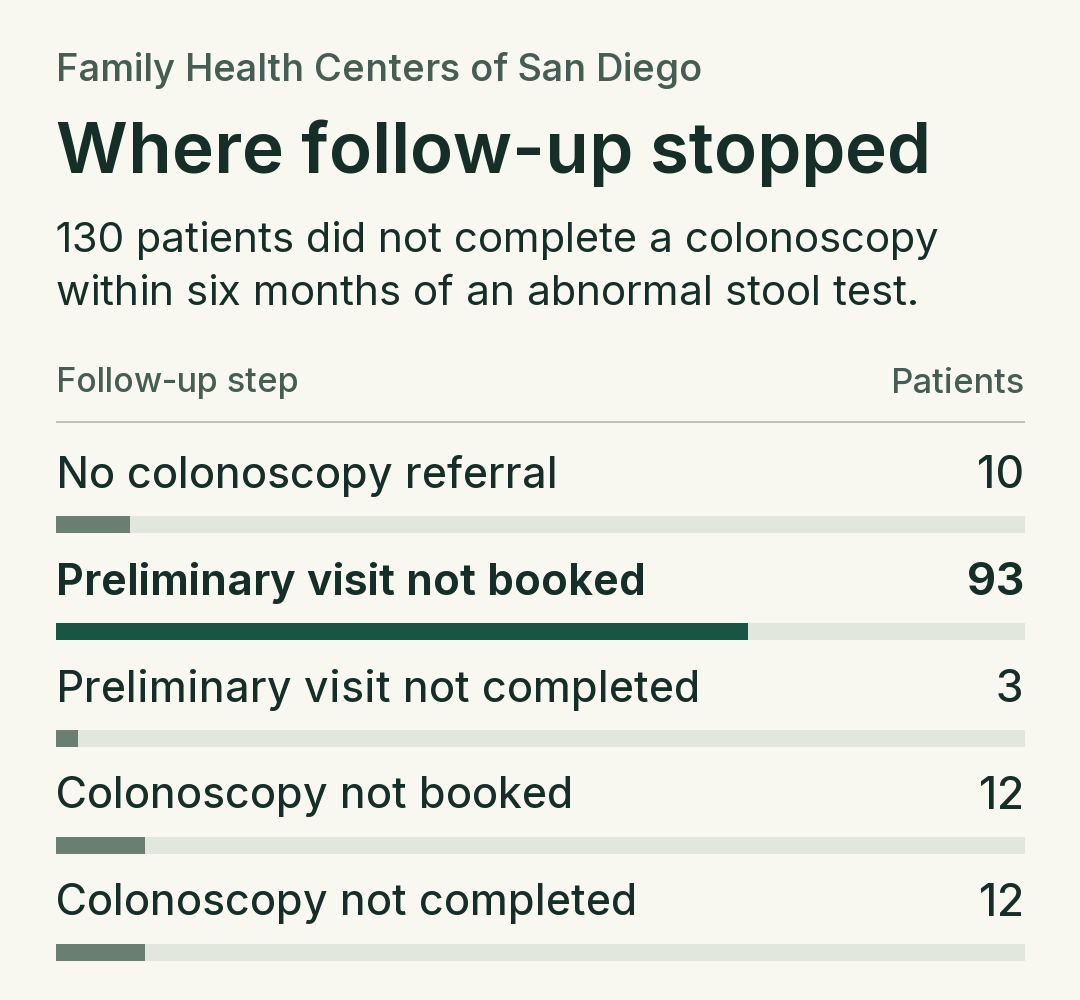
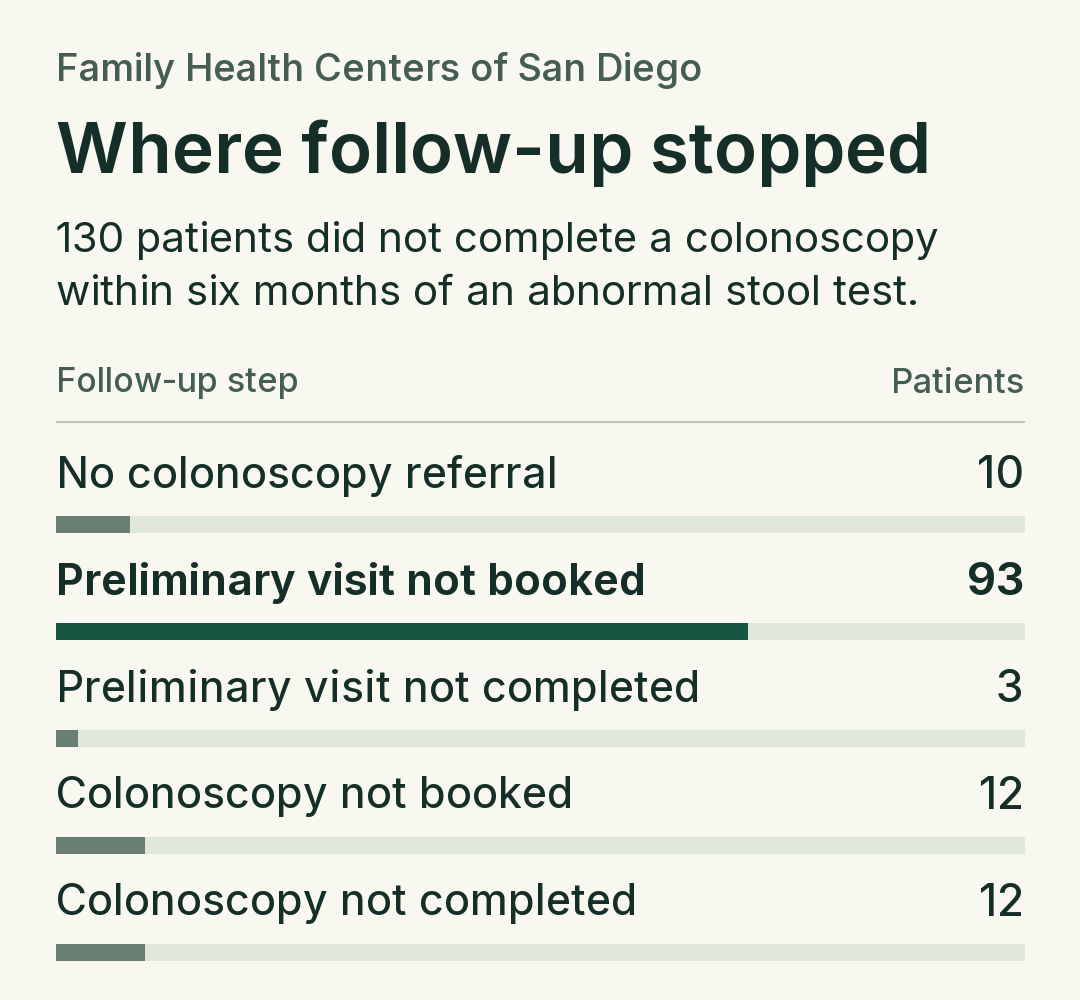
At Family Health Centers of San Diego, the revealing detail was the visit before the procedure. Researchers followed patients after an abnormal stool screening test. Of the 130 who did not complete a colonoscopy within six months during the project’s intervention, 93 had stalled at booking the preliminary specialist visit. A reminder about the procedure would have skipped the step those patients still needed.
Denver Health found a different problem. Its system already sent cancellation and missed-appointment alerts. They sat unread in referring clinicians’ inboxes. The clinic redirected them to clerks, medical assistants and patient navigators who could help rebook. Before adding another reminder, a practice can check exactly where its last one went and whether the recipient could act on it.
Sources (2)
Sometimes the missing consult note is already in the chart
Closing the referral loop means the referring team knows the consultation took place, has the specialist’s answer and knows who will act on it. A confirmed booking is useful earlier in the process. It gives the coordinator a time to check back.
Even when the answer comes back, the order may still look open. In a Massachusetts pilot, some specialist notes could not be linked electronically because the appointment date in the note differed from the one on the referral. In that situation, another request to the specialist can produce a second copy of a note the clinic already has. First check whether a returned document is waiting to be matched to the patient and visit.
Sources (2)

How the findings relate to Linear Health’s referral work
Several problems we documented fall within the work Linear Health already handles. An incoming fax can become a referral in the electronic health record (EHR), with uncertain details held for staff review. For an outgoing referral, Linear can find a specialist, contact the patient to arrange a visit, and follow up with the receiving office for the consultation note.
For screening outreach, Linear can check a payer’s list against the chart so staff can review cases that already have a recorded outcome. It can also submit prior authorization requests and track their status on the payer portals a clinic uses. The receiving office confirms what it can accept, the payer decides coverage, and clinicians answer clinical questions.
Back at Sea Mar, navigators described sometimes reaching a patient who had already completed the colonoscopy. They wanted overdue-call reminders and information they could use in their clinic’s existing record. For the navigator checking every patient on Monday, knowing which call could come off the list mattered just as much as knowing which one to make.
30 referral coordination questions, answered
Use these answers when a referral stalls. Each one links to the clinic report, survey or study that documented the problem.
Receiving and routing a referral
7 questions
- How do we identify a fax when the filename tells us nothing?
Open the document and match its patient identifiers, sender and purpose to the order before filing it. Keep uncertain matches in a review queue so staff can check what has already arrived before requesting another copy.
Read source, VA inspector general’s review of incoming community-care records- How can staff avoid retyping every fax?
Extract the patient, sender, service and coverage details into the referral record. Match them against the existing chart. Ask staff to check discrepancies against the original fax.
Read source, UCSF observation of pediatric referral intake- How do we find urgent referrals in a routine fax queue?
Give staff a way to flag sender-marked urgency wherever it appears on the page. Include unfamiliar forms and handwritten markings in intake checks. A clinician handles uncertainty about urgency.
Read source, Stanford Medicine’s account of sorting urgent faxes- What if the reason for referral is unclear?
Ask the ordering clinician what question they want the specialist to answer. Add that question to the request so the specialist sees it at review.
Read source, San Francisco General Hospital survey of consulting specialists- How do we handle a long packet that buries the important details?
Identify where the requested results and notes appear in the packet. If a required item is absent, tell the sender which one. Keep the full original available for clinical review.
Read source, Interviews with consultants and referring clinicians about referral packets- How do we catch a missing lab or imaging report before a visit?
Have each specialty specify which documents it needs for a given referral. Check against that list at intake and request only the missing material.
Read source, Dartmouth-Hitchcock endocrinology referral audit- What happens if a referral reaches the wrong specialty?
Return the reason to the referring office and assign someone to redirect the order. Ask the ordering clinician to resolve any uncertainty about the right specialty.
Read source, VA chart review of discontinued referrals
Finding an accepting specialist and checking coverage
6 questions
- What should we do when the specialist directory is wrong?
Confirm the office and location with the receiving practice and correct the shared entry. Record who confirmed it so colleagues can use the same contact.
Read source, Pennsylvania provider directory recheck- How do we find a specialist who accepts this particular plan?
Check the patient’s exact plan, the service and the location, then confirm the office is accepting new patients. Record the response so another coordinator can pick up where the search stopped.
Read source, NORC clinician focus groups for MedPAC, p. 26- How can we reduce repeated insurance eligibility calls?
Put the coverage response beside the referral where both intake and scheduling can see it. Route an unclear response or a change of coverage to a person for verification.
Read source, MGMA poll of practice leaders on phone workload- How do we know whether a service needs prior authorization?
Check the payer’s current requirements for the patient’s plan and requested service. Record the answer and its source. Keep any unresolved requirement visible to the person booking the visit.
Read source, AMA survey of physicians who handle prior authorizations- How can we follow up on a submitted authorization?
Save the payer’s reference number with the referral, track the portal status and assign the next check. If the payer asks for more material, name the item and who will supply it.
Read source, Cleveland Clinic and CAQH staff survey on authorization status- What should the scheduler see if coverage is denied or pending?
Show the actual payer decision beside the booking task and name the person handling follow-up. The treating team decides the clinical next step while staff keep the patient informed.
Read source, Memorial Sloan Kettering review of initially denied authorizations
Reaching the patient and booking the right visit
8 questions
- What if the phone number on the referral is wrong?
Verify the contact details with the referring office. Use another channel the patient has authorized when available. Record the invalid number so the next shift avoids another unsuccessful call.
Read source, Pittsburgh pediatric referral scheduler survey- What should we tell a patient who is waiting for a specialist to call?
Give them the office name, who will call whom, the expected contact window and a number to use if that window passes. Give the same instructions to the staff member handling follow-up.
Read source, Patient interviews about delayed specialty follow-up- How do we spot referrals that are ready but still unbooked?
Track the interval between being ready to schedule and booking. Give one team responsibility for first contact and keep unsuccessful attempts visible until the referral has an outcome.
Read source, Seattle Children’s study of outbound referral scheduling- What if a patient cannot navigate the scheduling menu in their language?
Offer the language choice before requiring keypad input. Provide a route to staff or an interpreter when the automated system cannot help with that language.
Read source, Multilingual caller audit at US cancer hospitals- How can a navigator find just the calls due today?
Give each open referral a next action, owner and due time. Show overdue calls and those due today together with the last attempt, so the navigator can start calling without rereading every entry.
Read source, PRECISE interviews with Sea Mar patient navigators- How can schedulers track one appointment across several systems?
Choose the clinic’s scheduling system as the record of the booking. Write confirmations, changes and cancellations back there and reconcile updates that fail to transfer.
Read source, GAO review of VA appointment scheduling systems- What if the receiving office closes a referral before the patient books?
Confirm that office’s acceptance window, set a follow-up before it ends, and check the requirement for reopening. Expiration policies vary even among practices in the same specialty.
Read source, Washington health center and gastroenterology staff interviews- Who should get a cancellation or missed-visit alert?
Route it to a team that can contact the patient and arrange another time. Keep the referral open until staff record the new booking or document another outcome.
Read source, Denver Health’s referral follow-up account, American College of Physicians
Receiving the specialist’s answer
6 questions
- How can we retire a separate referral spreadsheet?
First identify what staff depend on it for, such as the fax date, visit and attendance. Put those fields and the next action in a shared referral record and confirm staff can retrieve them before retiring the sheet.
Read source, Coulee Medical Center’s dental referral workflow, p. 3- What should we do when an outside consult note never comes back?
Confirm the visit took place, check incoming records, then ask the specialist’s office for the specific note. Record that request and who will check again if the note is still missing.
Read source, VA staff interviews about cross-institution referrals- What if the note has arrived but the referral still shows as open?
Compare patient identifiers, specialist and visit details with the original order. Send an uncertain match for manual review before linking the note or requesting another copy.
Read source, Massachusetts referral-management pilot on linking consultation notes- Which visit triggers a request for the final report?
For multi-visit care, agree with the receiving practice on the event that ends the referral and who will confirm it. Keep interim notes distinguishable from the final report.
Read source, GAO review of final documentation for VA community behavioral health referrals- Why does a referral report show missing work that staff already did?
Check which EHR field the report reads and where staff actually documented the action. Use a completed case to verify that a recorded outcome appears in both the worklist and the report.
Read source, RAND health center evaluation for CMS, Appendix A, p. 152- How do we keep families from having to relay the specialist’s advice?
Send the consultation note directly to the referring team. Give the family a contact and next step, and assign a clinician to review the specialist’s recommendations.
Read source, Pediatrics study of parents as information intermediaries
Following up on screening and the next appointment
3 questions
- Why is someone on our outreach list when they were already screened?
Reconcile the outreach list against the chart and outside reports before calling. Check whether the record shows a completed test, a pending referral or a result that still needs verification.
Read source, STOP CRC safety-net clinic screening record audit- What happens after the clinic gives someone a home screening kit?
Track whether the kit was returned and whether a result arrived. Follow up on overdue returns and arrange a replacement if the patient reports that the kit was lost.
Read source, North Carolina community health center interviews about screening kits- Which appointment should we chase after an abnormal screening result?
Follow the care team’s plan and record each required appointment separately. If the specialist needs a preliminary visit, check that it was booked and completed before following up on the procedure.
Read source, Family Health Centers of San Diego study of abnormal screening follow-up
How we reported this story
We selected US sources that documented a specific task a referral team, clinic or patient had to perform. For each one, we identified the point where work stalled or had to be repeated, wrote a question in clinic language, and linked the answer to its source. Each figure describes its own setting. The original researchers conducted the interviews, and Linear Health wrote the field guide. The product descriptions come from Linear Health.
Sources
Reporting sources (30)
- VA inspector general’s review of incoming community-care records
- UCSF observation of pediatric referral intake
- Stanford Medicine’s account of sorting urgent faxes
- San Francisco General Hospital survey of consulting specialists
- Interviews with consultants and referring clinicians about referral packets
- Dartmouth-Hitchcock endocrinology referral audit
- VA chart review of discontinued referrals
- Pennsylvania provider directory recheck
- NORC clinician focus groups for MedPAC, p. 26
- MGMA poll of practice leaders on phone workload
- AMA survey of physicians who handle prior authorizations
- Cleveland Clinic and CAQH staff survey on authorization status
- Memorial Sloan Kettering review of initially denied authorizations
- Pittsburgh pediatric referral scheduler survey
- Patient interviews about delayed specialty follow-up
- Seattle Children’s study of outbound referral scheduling
- Multilingual caller audit at US cancer hospitals
- PRECISE interviews with Sea Mar patient navigators
- GAO review of VA appointment scheduling systems
- Washington health center and gastroenterology staff interviews
- Denver Health’s referral follow-up account, American College of Physicians
- Coulee Medical Center’s dental referral workflow, p. 3
- VA staff interviews about cross-institution referrals
- Massachusetts referral-management pilot on linking consultation notes
- GAO review of final documentation for VA community behavioral health referrals
- RAND health center evaluation for CMS, Appendix A, p. 152
- Pediatrics study of parents as information intermediaries
- STOP CRC safety-net clinic screening record audit
- North Carolina community health center interviews about screening kits
- Family Health Centers of San Diego study of abnormal screening follow-up