



Outbound referral management: how to match patients with the right specialist
Outbound referral management is the sending side of referrals: choosing the right specialist and tracking the referral to completion. Good matching weighs network status, payer acceptance, proximity, patient preference, and real appointment capacity. The workflow then runs from order to sent packet to scheduled appointment to confirmation and consult note return, with every step tracked.

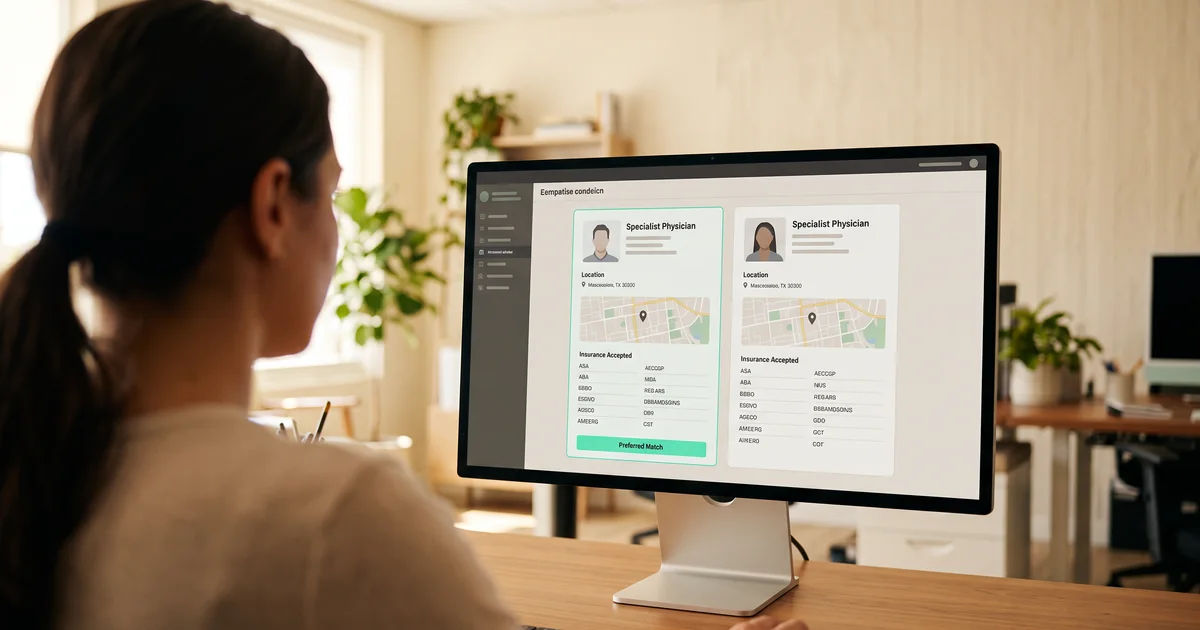
When an outbound referral fails, the failure usually happened in the first five minutes: the wrong specialist was chosen. The office does not take the patient's plan, or is 40 miles from the patient's home, or has no openings for two months. Everything downstream (the phone tag, the no-show, the patient who gives up) traces back to a matching decision made with stale or missing information.
Yet most practices still match by habit. The coordinator refers to the specialist the practice has always used, or the one whose name the provider remembered, with no systematic check against the patient's insurance, location, or the specialist's actual availability. This article is the playbook for doing it deliberately: the matching criteria, the workflow from order to consult note return, and how one large multi-site organization runs it at scale. For how the sending side differs structurally from receiving, see inbound vs outbound referral workflows; this piece stays on the outbound side.
What outbound referral management covers
Outbound referral management is the set of workflows a practice uses to send patients to external specialists and track those referrals through to a completed, documented visit. It spans five jobs: capturing the referral order, selecting the specialist, transmitting the referral packet, getting the patient scheduled and seen, and retrieving the consult note.
The stakes are the same as everywhere in referral operations: industry referral completion runs around 50 to 65 percent in generic contexts, and every incomplete outgoing referral is delayed care for the patient and, in value-based arrangements, an open care gap for the practice. Referrals that complete outside your intended network are their own cost; if that concept is new, start with what referral leakage is.
What makes the outbound side distinct is that the hard decision comes first. Inbound work is mostly throughput (process what arrives), while outbound work begins with a choice among specialists, and the quality of that choice determines everything after it.
The specialist matching problem
A good match must satisfy several constraints at once, and the constraints live in different systems. Network status lives in your contracts and referral policies. Payer acceptance lives in the specialist's front office and changes without notice. Proximity and preference live with the patient. Capacity lives in the specialist's scheduling system, invisible from outside. Clinical fit lives with the ordering provider.
Manual matching collapses under this because a coordinator cannot check five sources per referral at volume, so they fall back to memory and habit. The practical failure modes:
- The payer surprise. The specialist stopped accepting the patient's plan last quarter; the patient finds out at check-in or, worse, via the bill.
- The capacity trap. The chosen specialist books 8 weeks out while an equally qualified one nearby had openings this week. Long waits are a leading driver of patients abandoning referrals or self-referring out of network.
- The distance dropout. The patient agrees to the appointment, then does not make the 45-minute drive. Distance shows up later as a no-show, disguised as patient unreliability.
- The concentration habit. All volume flows to one favored practice regardless of fit, which both worsens waits there and weakens your leverage across the rest of your network. Deliberate referral network development is the structural fix.
Whether a specialist office accepts and acts on your referrals is itself measurable and varies widely; specialist referral acceptance rates covers that dimension. The matching system below treats acceptance behavior as data, not folklore.
Matching criteria, in order
Apply the criteria as ordered filters: each row narrows the candidate list, and the order matters because the early criteria are hard constraints while the later ones are optimizations.
| Criterion | Question it answers | Data source and strength |
|---|---|---|
| 1. Network status | Is this specialist in our intended referral network and in the patient's plan network? | Contracts and payer directories. Hard constraint. |
| 2. Payer acceptance | Does the office currently accept this specific plan and take new patients on it? | Specialist office, verified recently. Hard constraint. |
| 3. Clinical fit | Does this specialist handle this condition and urgency, per the ordering provider? | Ordering provider and subspecialty data. Hard constraint. |
| 4. Proximity and patient preference | Can and will the patient get there? Language, gender, hospital affiliation, telehealth? | Patient conversation. Soft, but decisive. |
| 5. Appointment capacity | Can the patient be seen within the clinically appropriate window? | Live scheduling data or recent wait-time history. Soft, often the tiebreaker. |
Two notes on using the table. First, criterion 2 is not the same as criterion 1: a specialist can be in-network on paper and still have closed their panel to a plan. It has to be verified against current reality, not last year's directory. Second, criterion 5 deserves more weight than it usually gets. A technically perfect match with a 10-week wait frequently produces a worse outcome than a good match seen next week. Matching on live availability is exactly the problem provider scheduling logic and appointment matching exists to solve.
For urgent referrals, run the same filters with a compressed capacity window and the ordering provider's direct input; clinical prioritization always belongs to the ordering provider, not to the matching system. Long-wait specialties need this most, which is why the neurology referral management playbook leans so heavily on triage and capacity.
The outbound workflow, order to note return
Once the specialist is chosen, the referral moves through a trackable sequence. Give each step a named status so stalls are visible:
- Order captured. The referral order is complete: reason, urgency, relevant clinicals, insurance. Incomplete orders bounce back to the ordering provider now, not three steps later.
- Specialist matched. The criteria above are applied and the selection recorded, including the runner-up (useful when the first choice falls through).
- Packet sent. Demographics, insurance, clinical summary, and the documentation-return request go to the specialist through their preferred channel, with transmission confirmed, not assumed.
- Patient contacted. Outreach begins immediately. This step is where manual workflows lose days. Automated outreach makes first contact in ~5 min. Speed here directly moves conversion, because patient motivation decays fast after the visit where the referral was ordered.
- Appointment scheduled. The visit is booked and the date recorded in your system, not just the specialist's.
- Visit confirmed. Reminders run before the visit, and attendance is confirmed after it. No-shows and cancellations route back to step 5, not into silence.
- Consult note filed. The specialist's report is retrieved, matched to the referral, filed to the chart, and routed to the ordering provider. Only now is the referral closed.
Every stalled state gets an aging rule (for example: packet sent but patient not scheduled within 5 business days triggers escalation).
Keep the specialist directory alive
The matching table is only as good as the data behind it, and specialist data rots quickly: practices move, close panels, drop plans, and change fax numbers constantly. Payer-published directories are notoriously unreliable as a sole source; CMS has repeatedly found accuracy problems in plan provider directories, which is exactly why your own verified directory is worth maintaining.
A minimal maintenance discipline:
- Verify on failure. Every bounced fax, refused referral, or payer surprise triggers a directory correction the same day.
- Verify on cadence. High-volume specialists get a quarterly confirmation of payers accepted, new-patient status, and typical wait; the long tail gets an annual pass.
- Capture wait-time reality. Record actual time-to-appointment on your own referrals per specialist. Your own referral history is the most honest capacity signal you have.
- Record acceptance behavior. Which offices confirm receipt, schedule promptly, and return notes. This feeds both matching and your quarterly network conversations.
How Aunt Martha's runs outbound at scale
Aunt Martha's Health & Wellness. Community health organization in the Chicago area, more than 100 providers across more than 20 locations, on athenahealth. Referral coordination, care gap closure and voice AI running across the network.
Coordinators oversee the automated workflow and handle the exceptions.
For a single-site practice the same design applies at smaller numbers: criteria-based matching, status-tracked workflow, exception-only human work. The architecture is what scales, which is why it is worth building correctly even at low volume, ideally on a platform built for outbound referral coordination.
Measuring outbound performance
A short scorecard is enough to run the outbound side. Track monthly, per site and per specialist:
- Referral completion rate: share of outgoing referrals ending in a completed visit.
- Time to first patient contact: target minutes-to-hours. Compare with your own manual baseline.
- Time to appointment: from order to scheduled slot, your live measure of network capacity.
- In-network completion share: leakage, measured rather than guessed.
- Consult note return rate: share of completed visits with the note filed within your defined window, the closing metric of the whole pipeline.
Review the per-specialist cut quarterly and let it drive both matching weights and network conversations. Specialists who schedule fast and return notes earn volume; chronic stalls get a direct conversation or a smaller share of matches.
The bottom line
Outbound referral management is a matching problem followed by a tracking problem. Match on five criteria in order (network status, payer acceptance, clinical fit per the ordering provider, proximity and preference, real capacity), keep the directory behind those criteria alive, and run every referral through a seven-state pipeline with aging rules on the stalls. Done manually, this collapses at volume, which is why organizations like Aunt Martha's automate the routine steps and reserve people for exceptions.
FAQ
What is outbound referral management?
How do you choose the right specialist for a referral?
Why do outgoing referrals fail so often?
What should be included in an outbound referral packet?
How fast should a patient be contacted after a referral is ordered?
How is outbound referral management different from inbound?
Sources
- Centers for Medicare & Medicaid Services (CMS), provider directory and network adequacy resources, cms.gov
- Agency for Healthcare Research and Quality (AHRQ), care coordination resources, ahrq.gov
- Office of the National Coordinator for Health Information Technology (ONC/ASTP), interoperability resources, healthit.gov