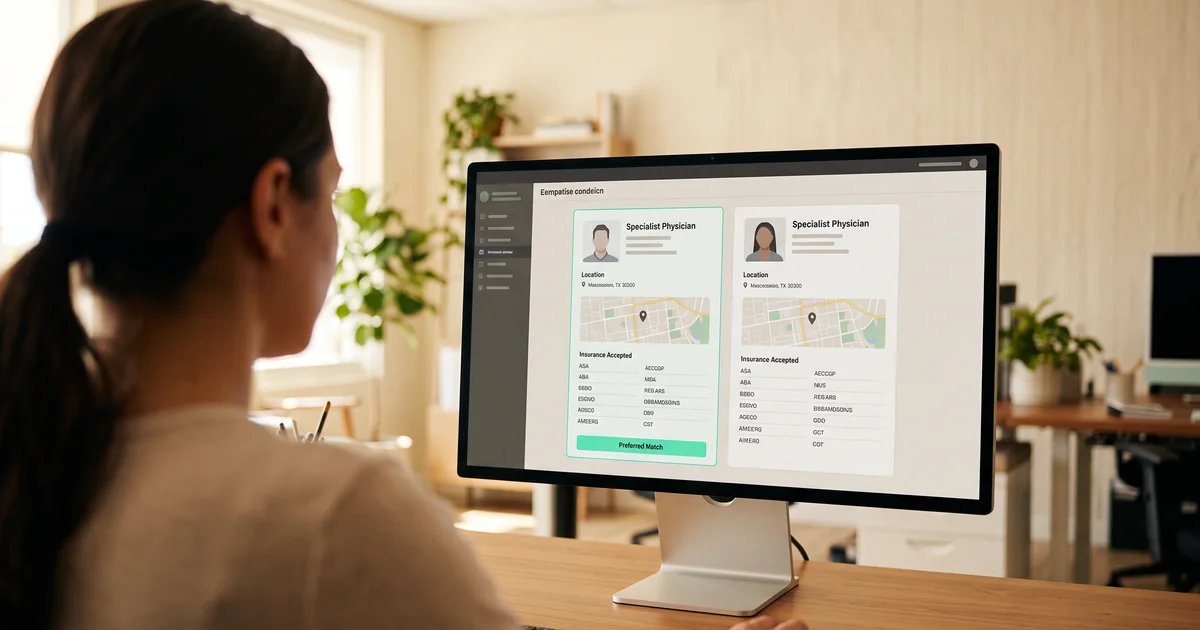
Rural specialty referrals when the nearest office is closed to new patients
Build a verified list of feasible specialist options, compare travel and visit format with the patient, and give unresolved referrals an owner.


Find out what “not accepting” means
An office may be closed to all new referrals, closed at one location, unable to provide the specific service, or temporarily unable to offer a date. Ask which condition applies. Preserve the date, source and exact response. If the office names another site, verify that site directly rather than sending the packet to a new address on the strength of a suggestion.
Record a local directory correction separately from the patient’s referral. “No new visits for this plan at the west office as of Tuesday” is useful to the next coordinator. It also has narrower scope than a permanent flag against the specialist. Related: How to maintain a specialist referral directory.
Compare the options the patient could use
| Possible route | What the practice confirms | What the patient needs to know |
|---|---|---|
| Another regional office | Intended specialty or service, new-patient intake, member-specific network check and first offered appointment | Site, travel requirements, date and whom to call |
| A visiting specialist at a closer clinic | Next clinic session, intake process and whether this referral is eligible | Which building to attend and whether later visits may require travel |
| An approved video consultation | Clinical suitability confirmed by the responsible team, participating sites and available appointment | Whether the patient joins from home or attends a local site, and how to get help connecting |
| No feasible option yet | What was checked, the unanswered question and the responsible clinical or access lead | When the practice will update the patient next |
UC Davis Health describes a provider-to-provider telehealth referral pathway for contracted sites, in which the patient, local primary care provider and specialist participate. It illustrates why a scheduler should check the actual service arrangement before telling someone they can attend from home. HHS also notes that telehealth can reduce travel for some rural patients. The treating team and receiving service decide which format is appropriate. Sources: UC Davis Health contracted telehealth referrals and HHS rural telehealth guidance.
An example in which the closest site is not the easiest trip
Suppose the local specialist declines a new referral. A second office across the county offers an early-morning appointment that the patient cannot reach. A regional service offers a later appointment through a contracted local telehealth site. The coordinator verifies that this site participates, has a private room available at that time and can receive the referral. The ordering team confirms the proposed format fits the request. The patient can now compare two concrete offers.
If the local site has no room that day, keep the appointment option marked provisional. If the patient prefers in-person care despite the longer trip, record that preference and identify the next feasible date. A directory match or an invitation to join a waitlist supplies no evidence of a booked visit.
When the search comes up empty
Give the ordering team a short summary of the offices contacted, their responses, the patient’s stated limits and the next follow-up time. A coordinator can establish that no suitable appointment has been found. Decisions about clinical timing, a different specialty or a change in treatment belong to the clinician. Keep ownership with a named person until the receiving practice accepts the request and the patient knows the next step. Related: Linear Health’s outbound referral workflow.
Where Linear Health fits
When no local specialist has an opening, the patient needs a real option instead of a stalled referral. Linear Health's outbound referral coordination completes the routine steps on this work, records each one in your EHR, and hands exceptions like this to a member of your team with the context needed to act. It is operational AI: it handles the administrative work and never makes a clinical decision.
Best fit: specialty practices, primary care groups, FQHCs and multi-location groups where referral volume keeps coordinators on the phone. Not a fit: solo practices too small to justify the volume, hospital enterprise systems, or anyone looking for clinical decision support.
The first workflow goes live in 4 weeks, up to 80% of coordination work is automated, and every proposal is built against your own numbers. Run your numbers or book a demo and we will walk through one of your own referrals.
Questions from rural referral teams
Should staff send the referral to every office at once?
Does a payer directory confirm an office can schedule this patient?
Can a specialist eConsult replace the requested visit?
What travel information should staff ask about?
When can a case leave the search queue?
Sources
Linear Health publishes educational articles about operational AI for healthcare.