After the Telehealth Visit: Build a Referral Handoff That Reaches Local Care
Map the work between a virtual visit and a local appointment, with named owners, accepted handoffs and status returned to the referring team.


The worksheet below is a proposed design for teams to adapt and evaluate. It is not a tested operator protocol or a recommendation about which clinical service a patient needs. Orders, urgency and changes to the care plan remain with the clinicians and policies responsible for those decisions.
Why the work after the visit deserves its own check
HHS explains that follow-up after a telehealth visit may include another appointment, provider or test. The visit ending and the next service happening are different events.
There is also relevant US research. A 2023 retrospective study in JAMA Network Open examined selected tests and referrals ordered during 2020 and 2021 at two affiliated Boston primary care sites. Completion was lower for orders made during telehealth visits than during in-person visits. The study describes a local workflow in which telehealth patients received a scheduling telephone number during the visit, without subsequent scheduling reminders.
That study does not establish a national telehealth completion rate, prove that visit modality caused the difference or validate the worksheet below. It supports examining what happens between an order and the patient's next appointment. Its measurement windows are research definitions, not clinical waiting-time instructions.
This guide concentrates on the handoff from a virtual team to local care. The broader outbound referral process covers the entire order-to-note journey. The telehealth solutions page addresses commercial fit.
Give the remote team a usable local destination
Begin with the documented referral, then add the information needed to coordinate the proposed destination. A city or provider name alone is not a complete handoff record.
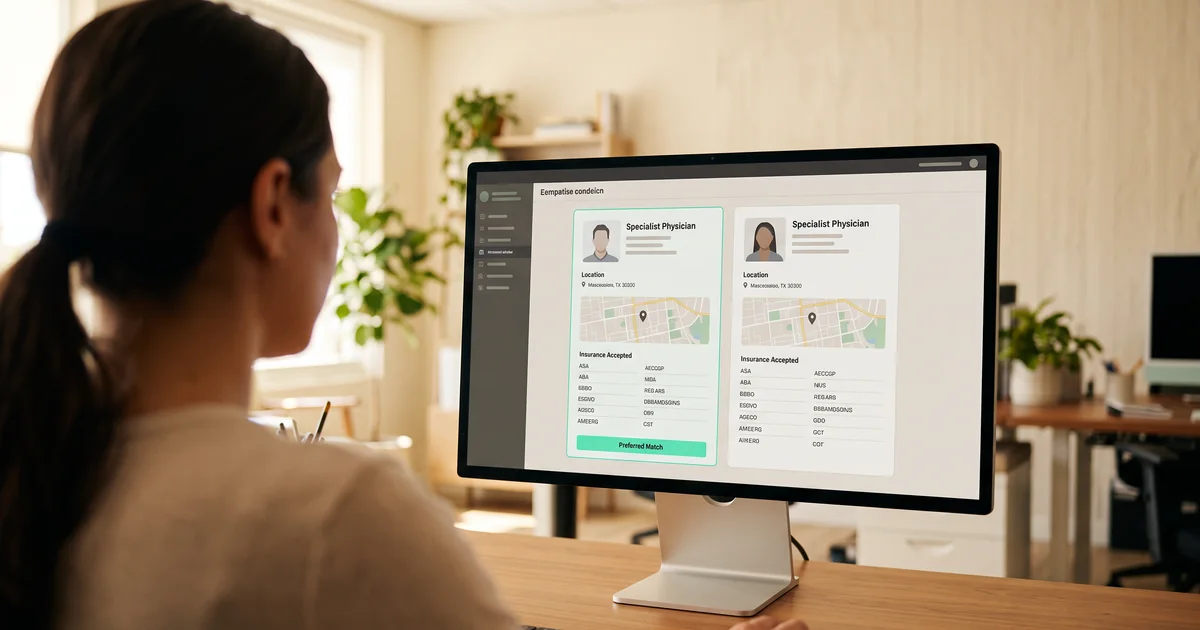
For a virtual service coordinating across locations, consider a distinct destination block containing the actual office address, scheduling contact, patient-confirmed travel area and appointment time zone. Record where each detail came from and when it was checked. A directory entry, a conversation with the office and a patient's preference are different evidence sources.
The following fields are an original worksheet proposal. They are not a prescribed data standard or a claim about a particular software product.
| Field | What to record | Question it should answer |
|---|---|---|
| Encounter and order reference | Link to the clinician's documented request | Which request is this handoff carrying? |
| Local destination | Office, address and scheduling contact | Which location is expected to receive it? |
| Patient preferences | Confirmed travel area, availability and communication needs | What has the patient actually told the team? |
| Destination response | Receipt, acceptance or unresolved question, with its source | What has the receiving office confirmed? |
| Open task | Next action, responsible team and locally assigned checkpoint | Who is working on the remaining step? |
| Return route | Responsible virtual team and appropriate inbox or record | Where should the outcome go? |
If a destination cannot meet the request, record that response. Do not quietly substitute a different service, change urgency or infer permission to change the order. Route the question through the practice's authorized process.
Separate a transmitted packet from an accepted handoff
AHRQ's referral guidance recommends agreements that define information exchange and the roles of both practices. It also recommends direct communication between offices, appointment assistance and referral tracking.
Translate that principle into evidence fields rather than a single vague status. For this worksheet, use the following distinctions:
- Sent: The sending team has evidence of transmission to an identified destination.
- Received: The destination has acknowledged receipt through the agreed channel.
- Accepted for the next step: The receiving team has stated what it will do next.
- Booked: There is a confirmed appointment record, including location and time zone.
These are proposed coordination labels. Map them to your existing system and define them with the receiving office before use. An automated transmission receipt does not answer every question about the receiver's subsequent work.
If the response is "records needed," keep that request visible with its owner. If the office is considering acceptance, record that state without converting it into a booking. Preserve the response itself, not only the status selected by the coordinator.
Make the patient message match the current state
Use the same confirmed facts in the coordination record and the patient communication. A proposed patient-message structure has four parts: what has happened, what remains pending, who is taking the next action and whom to contact with questions.
For example, a team could explain that the local office has received the referral but has not yet confirmed an appointment. That statement should come from the actual office response. It should not be replaced with "you are all set" while booking remains unresolved.
Record the patient's requested help or changed preference in the handoff. When scheduling is confirmed, include the actual location and time zone rather than relying on the virtual team's office location. Keep clinical instructions tied to the authorized clinician or receiving office; a coordination message should not invent preparation instructions.
Work through one explicitly fictional handoff
Consider this fictional worksheet exercise. A virtual clinician documents a local referral. The patient identifies a preferred travel area. The first receiving office replies that the request must go to another location within its group.
The coordination record should make the unresolved destination question visible. The proposed next step is to confirm the correct location and determine whether the change needs clinical clarification under the practice's policy. The exercise contains no assumed permission to change the service or order.
After the destination is confirmed, the team records the receiver's next action. A later booking event adds the appointment details. The virtual team then receives a status update distinguishing the booked appointment from any later attendance evidence or consultation report.
This example demonstrates how to fill the worksheet. It is not a customer case, and it supplies no performance result.
Return evidence to the team that can use it
Specify the destination for updates before sending the referral. A rotating virtual workforce may use a shared workflow, an assigned clinician or another approved arrangement. Record the arrangement actually in place instead of assuming that a message to the original sender reaches the current owner.
Keep booking, attendance and consultation documentation in separate fields. Use the consult-note return guide for the later documentation task. The proposed handoff worksheet should link to that work, not replace it.
For an initial local evaluation, examine whether a reviewer can follow every included encounter to its current disposition. List missing acknowledgments, unresolved destinations and updates without a receiver. Choose observation periods and escalation rules locally. Report what was observed without claiming that the worksheet has improved completion before that has been measured.
Connect the visit with its next step
A useful handoff lets the next person see the destination, the latest confirmed response and the task still to do. Book a demo to discuss referral coordination for your telehealth team.
Frequently asked questions
Who owns the next step after a telehealth visit ends?
What proves that a local office accepted the referral?
What should the worksheet record about location and time zone?
What happens when the proposed destination cannot accept the request?
Which status should return to the virtual team?
Sources
Linear Health publishes educational articles about operational AI for healthcare.