



Voice AI for Patient Scheduling: How Outbound Calling Automation Fills Appointment Slots
A referral comes in. The patient is in your system. The appointment slot is open. And then nothing happens, because nobody called. Outbound calling is where most scheduling revenue is won or lost, and it's the workflow that coordinators cannot keep up with manually.

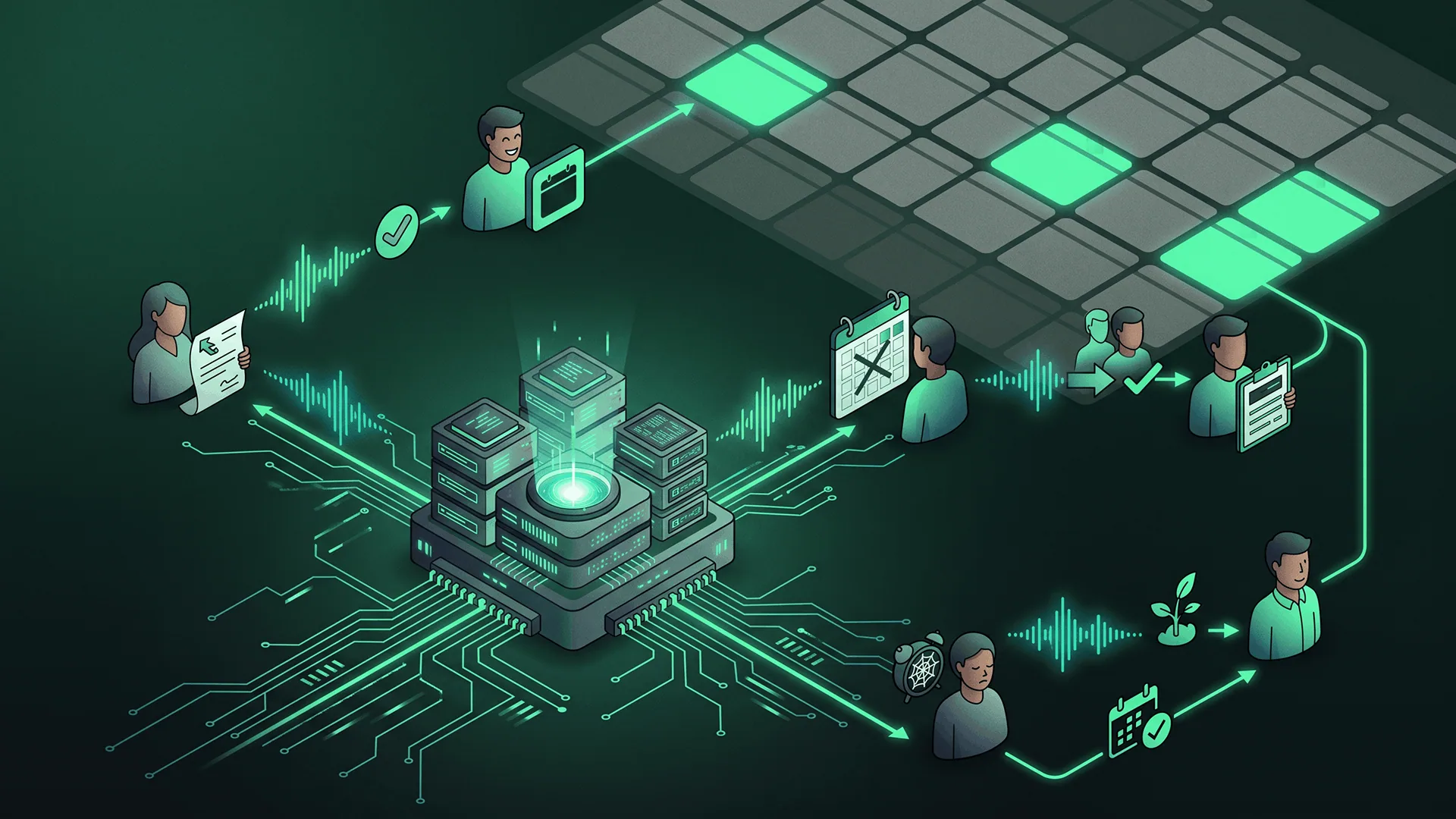
There is a version of this problem that every practice manager knows. A referral comes in. The patient is in your system. The appointment slot is open. And then nothing happens, because nobody called.
Not because the coordinator forgot. Because there were 40 other things to do, a stack of faxes to process, and a phone that kept ringing with inbound requests. The outbound call to that referred patient never went out. Three days later, they booked somewhere else.
This is the scheduling gap that almost no one talks about. The industry conversation around voice AI in healthcare has been almost entirely focused on inbound: answering calls faster, reducing hold times, handling after-hours overflow. Those are real problems worth solving. But they miss the bigger revenue opportunity sitting on the other side of the equation.
Outbound calling is where most scheduling revenue is won or lost. And it's the workflow that coordinators, under normal staffing conditions, cannot keep up with manually.
Voice AI changes that math entirely.
Why is the industry's inbound obsession costing you outbound revenue?
The data on inbound call performance in healthcare is striking. Healthcare misses 32% of inbound calls, the highest miss rate of any industry. 85% of those callers never try again. A practice fielding 80 calls per day is permanently losing over 20 patient interactions every single business day.
Those numbers have driven a wave of investment in inbound voice AI, and rightly so.
But here's what the inbound conversation misses: the patients you're losing to outbound failure were already yours. They came through a referral. They called your office once and left a message. They were on a recall list for a screening they're 14 months overdue for. They confirmed an appointment but then went silent.
These aren't cold leads. They're warm patients with established clinical need, and most practices have no systematic way to reach them proactively.
The outbound gap in numbers
The scale of the opportunity is large:
- Over 50% of inbound calls to medical practices are scheduling-related, yet practices rarely run equivalent outbound scheduling campaigns
- 85% of patients who reach voicemail on an inbound call will not call back, meaning the practice must initiate the next touch
- Practices using conversational AI for scheduling report 30-50% increases in appointment fill rates
- Automated voice calls cost 10-15% of what a live agent call costs, with platforms routinely achieving 50%+ call resolution rates without human involvement
The problem isn't that practices don't understand the value of outbound follow-up. It's that coordinators are already at capacity. You can't ask a team that's managing inbound volume, processing faxes, and handling prior authorizations to also work a 200-patient recall list every week. Something always gives, and it's usually the outbound calls.
Voice AI doesn't ask for more coordinator time. It runs in the background.
What does voice AI outbound calling do in practice?
Voice AI for outbound patient scheduling isn't a robocall system. It's a conversational agent that can hold a real, structured dialogue with a patient, understand their response, check live EHR availability, book the appointment, and send a confirmation, all without a coordinator touching the interaction.
The distinction matters because the failure mode of older automated outreach (press 1 to confirm, press 2 to cancel) was that it couldn't handle anything outside a narrow script. A patient who said "can I come in on Thursday instead?" hit a wall. Modern voice AI handles that naturally.
What are the core outbound use cases?
Referral-to-appointment conversion. When a new referral arrives, the AI places an outbound call to the patient, introduces itself as calling on behalf of the practice, explains the referral, and offers to schedule directly. If the patient doesn't answer, it leaves a natural voicemail and triggers an SMS follow-up. The goal is to convert a referral into a booked slot before the patient has time to call a competing practice. For a deeper look at where referrals fail in the handoff process, see our analysis of why referrals get lost between PCP and specialist.
No-show recovery and same-day backfill. When a patient cancels or doesn't show, the AI immediately begins working a waitlist, calling patients who requested earlier appointments and offering the newly open slot. This is a workflow that coordinators rarely have bandwidth to execute in real time. The AI does it within minutes of the cancellation.
Recall and reactivation outreach. Patients who are overdue for follow-up visits, annual screenings, or chronic care check-ins represent large latent revenue. The AI works through these lists continuously, reaching out to patients who haven't been seen in 12, 18, or 24 months and offering to get them back on the schedule. For FQHCs, this workflow directly supports care gap closure and UDS reporting.
Appointment reminders with live rescheduling. Rather than a one-way text reminder, voice AI can call the patient before their appointment, confirm attendance, and if the patient needs to reschedule, handle that conversation on the spot, offering alternatives and booking a new slot without any coordinator involvement.
What happens under the hood?
The key capability that separates functional outbound voice AI from glorified autodialers is EHR integration. The agent needs to read live provider availability, match the patient to the correct appointment type based on their clinical context, write the confirmed booking back to the schedule, and document the interaction in the patient record.
Without that bidirectional integration, you get a system that can have a conversation but can't complete the task. The appointment still has to be manually entered by a coordinator, which defeats the purpose.
The practical test: if a voice AI system can't confirm an appointment and have it appear in your EHR without a human touching it, it's a scheduling assistant, not scheduling automation.
Where does outbound voice AI deliver the most immediate ROI?
Not all outbound workflows are created equal. The return on voice AI deployment concentrates in a few specific scenarios.
Specialty practices with high referral volume
For specialty practices, the referral-to-appointment conversion window is the highest-stakes outbound workflow. When a PCP sends a referral, that patient is seeking care now. They may be calling multiple specialists. The practice that reaches them first and offers a convenient booking time wins the appointment.
Manual outreach means the call might go out the next day, or the day after, depending on coordinator bandwidth. Voice AI places the call within minutes of the referral arriving. Speed of first contact is one of the strongest predictors of whether a referral converts to a completed visit.
The revenue impact: a 12-provider practice in Ohio documented approximately $950,000 in annual lost revenue traced to 20 missed or delayed outbound calls per day, excluding downstream diagnostics and procedures.
Multi-site groups with recall backlogs
For primary care groups and multi-location organizations, the reactivation use case is often the fastest path to measurable revenue impact. Most practices have thousands of patients who are overdue for follow-up but haven't been contacted because nobody has time to work the list.
Voice AI can run recall campaigns continuously, in the background, across an entire patient population. A practice that hasn't worked its overdue patient list in 18 months can see immediate appointment volume lift from reactivation outreach alone, without adding a single new patient.
After-hours scheduling capture
Roughly 35% of patient calls arrive outside business hours or during peak periods when every line is occupied. Without automation, these calls go to voicemail, where 62% of patients hang up without leaving a message. The ones who do leave a message expect a callback the next morning, by which point many have already booked elsewhere.
Voice AI captures these calls in real time, regardless of when they come in. A patient calling at 8 PM to schedule a follow-up gets the same experience as one calling at 10 AM: immediate answer, live availability check, confirmed booking.
| Outbound Use Case | Primary Beneficiary | Time to First Revenue Impact |
|---|---|---|
| Referral-to-appointment conversion | Specialty practices | Days |
| No-show recovery and waitlist backfill | All practice types | Immediate |
| Recall and reactivation campaigns | Primary care, multi-site groups | 2-4 weeks |
| After-hours scheduling capture | All practice types | Immediate |
| Appointment reminder with rescheduling | All practice types | Days |
We were losing thousands in revenue to no-shows and delayed scheduling. Linear Health contacted our patients faster than we ever could and our show rates improved dramatically.
What does good implementation look like?
The gap between voice AI that works and voice AI that gets abandoned after 90 days usually comes down to three things: integration depth, escalation design, and workflow sequencing.
Integration depth
A voice AI agent that can't read your live schedule is just a message-taking service. The system needs bidirectional EHR access: reading provider availability in real time, writing confirmed appointments back to the schedule, pulling patient clinical context to match appointment types correctly, and documenting call outcomes in the chart.
Only 8% of healthcare AI pilots have reached production scale, and the gap consistently comes down to EHR integration depth. Systems that can't complete the full workflow end up creating more coordinator work, not less. For a detailed breakdown of what EHR integration means at the technical level, see our guide on voice AI scheduling and EHR integration.
Escalation design
Not every patient interaction should be handled by an AI. The system needs clear logic for when to escalate: a patient expressing clinical distress, a complex scheduling situation with multiple providers, or a prior authorization question that requires human judgment. Well-designed voice AI handles the routine 70-80% of interactions autonomously and routes the remainder to a coordinator with full context already captured.
The goal isn't to remove humans from patient communication. It's to make sure humans are spending time on interactions that require them.
Workflow sequencing
The practices that see the fastest ROI from outbound voice AI start with one high-volume, high-impact workflow rather than trying to automate everything at once. Referral conversion or no-show recovery are usually the right starting points because the revenue impact is immediate and measurable.
Once those workflows are stable, the system can be extended to recall campaigns, after-hours capture, and intake automation. Trying to deploy everything simultaneously tends to create integration and training complexity that slows adoption.
A reasonable deployment timeline for a specialty practice or primary care group:
- Weeks 1-4: Inbound scheduling and after-hours coverage live. Coordinators stop managing routine scheduling calls.
- Weeks 4-8: Outbound referral conversion and no-show recovery active. First measurable revenue impact visible.
- Weeks 8-12: Recall campaigns and reactivation outreach running. Patient population worked for the first time.
The 90-day mark is typically when practices can measure the full impact across all workflows and make a clear ROI case to leadership. For more on the broader conversational AI implementation path, including SMS and chat channels alongside voice, see our full implementation guide.
Who is this the best fit for?
Best fit:
- Specialty practices processing 100+ inbound referrals per month where speed of first contact directly determines conversion rates
- Multi-location groups and PE-backed networks with recall backlogs of 1,000+ overdue patients that nobody has bandwidth to work
- Practices with no-show rates above 15% that want same-day waitlist backfill running automatically
- FQHCs managing care gap closure campaigns across large patient populations with limited outreach staff
- Any practice where outbound coordinator calls are the bottleneck on scheduling fill rates
Less ideal fit:
- Solo practices or small groups with low call volume (under 30 calls per day). The ROI case takes longer to materialize when volume is low.
- Practices whose primary scheduling problem is inbound hold times rather than outbound follow-up. If patients are trying to reach you and can't get through, start with inbound voice AI before adding outbound workflows.
- Organizations that haven't resolved basic EHR scheduling configuration. Voice AI that writes to a misconfigured schedule creates more problems than it solves. Get your appointment types, provider templates, and slot logic clean first.
How do you measure whether outbound voice AI is working?
The fastest way to lose internal support for an outbound voice AI program is to deploy it and then report on the wrong number. "Calls placed" is a vanity metric. What leadership cares about is filled slots and recovered revenue, so the measurement framework has to connect the automation to the schedule and the schedule to the books.
The metrics that actually prove the program, by workflow:
- Contact rate: the share of attempted patients the AI actually reaches (live or via a voicemail-plus-SMS sequence that gets a response). This isolates list quality from booking performance.
- Conversion rate: of contacted patients, how many book an appointment. For referral conversion, track this against your old manual baseline, since this is where the revenue case is clearest.
- Time to first contact: minutes or hours between a referral or cancellation and the first outreach attempt. This is the metric voice AI moves most dramatically, often from days to minutes.
- Slot fill rate: the percentage of open or newly cancelled slots that get filled, especially same-day backfill from the waitlist workflow.
- Show rate on AI-booked appointments: tracked separately, to confirm that automated booking does not come at the cost of higher no-shows.
- Escalation rate: the share of interactions routed to a human. A healthy program runs autonomously on roughly 70 to 80 percent of interactions; a rising escalation rate flags a workflow or configuration problem early.
- Net revenue recovered: completed visits attributable to the automation, multiplied by average visit value, plus downstream diagnostics and procedures where you can attribute them.
The discipline that separates programs that survive budget review from those that don't is establishing the manual baseline before go-live. If you do not know your current referral conversion rate or recall list completion rate today, capture it first, then measure the lift. For the full financial model, see our voice AI ROI breakdown.
How does the coordinator role change?
One concern that comes up consistently is what voice AI means for the coordinators who currently handle scheduling calls. The honest answer: the role changes, but it doesn't go away.
What voice AI eliminates is the part of the coordinator's day that's most draining: the repetitive, high-volume calls that require no clinical judgment. Confirming appointments. Leaving voicemails. Working through a recall list of patients who may or may not answer. Rescheduling a cancellation by calling through a waitlist one patient at a time.
What it leaves is the work that requires a human: managing complex multi-provider scheduling, handling patients with clinical questions, navigating prior authorization issues, and building the referring provider relationships that drive inbound referral volume.
The practices that implement voice AI well don't end up with fewer coordinators. They end up with coordinators who are spending their time on higher-value work, experiencing less burnout, and handling a larger patient volume than they could before.
The referral coordination function doesn't get automated away. It gets elevated.
The scheduling slots are already there
Most practices aren't struggling with a shortage of appointment capacity. They're struggling with a shortage of systematic outreach to fill the capacity they already have.
The referred patients are in the system. The overdue patients are in the database. The cancelled slots are sitting open on the schedule. The after-hours callers left voicemails that nobody got to until the next morning, when the patient had already moved on.
Voice AI doesn't create new demand. It captures the demand that already exists but falls through the cracks of a manual outreach process that was never designed to scale.
The phone is still how 88% of patients book healthcare appointments. That isn't changing anytime soon. What can change is whether the practice is the one initiating those calls, or waiting for patients to call them.
If you're on athenahealth, Epic, or another major EHR and want to see how scheduling automation fits into your operations, the outbound workflows are the right place to start. That's where the revenue is sitting uncaptured.
Frequently asked questions
How is outbound voice AI different from a robocall or autodialer?
Does outbound voice AI replace coordinators?
What EHR systems does voice AI integrate with?
Which outbound workflow should we start with?
How quickly can we see ROI from outbound voice AI?
What metrics should we track to prove outbound voice AI is working?