





Referral Automation ROI After Go-Live: Prove the Benefits You Actually Realized
Measure referral automation ROI after implementation with comparable cohorts, an evidence ledger, cost reconciliation, and finance-approved benefits.
The Linear Health Journal
Practical guides to referral automation, prior authorization AI, care gap closure, AI voice agents, and patient scheduling. Written for the teams who run specialty practices, FQHCs, and PE-backed medical groups.
Key Takeaways
The Linear Health Journal publishes 161 practical guides on AI automation for healthcare operations: referral management, prior authorization workflows and CMS-0057-F compliance, care gap closure and HEDIS quality measures, AI voice agents for patient calls, patient scheduling and no-show reduction, and medical fax automation. Built for operational leaders at specialty practices, FQHCs and community health centers, and PE-backed multi-site medical groups.
Measure referral automation ROI after implementation with comparable cohorts, an evidence ledger, cost reconciliation, and finance-approved benefits.
Evaluate referral leakage benchmarks with matching denominators, observation windows, outcome definitions, and an illustrative comparison worksheet.
Measure referral automation ROI after implementation with comparable cohorts, an evidence ledger, cost reconciliation, and finance-approved benefits.
Evaluate referral leakage benchmarks with matching denominators, observation windows, outcome definitions, and an illustrative comparison worksheet.
Build a referral operations dashboard with clear formulas, event definitions, owners, worklists and reconciliation checks for six useful measures.
Prioritize healthcare workflow automation with a process-readiness scorecard, measurable boundaries, accountable owners, and a first-project charter.
Care gap management is the analytical work of identifying, stratifying, and monitoring open care gaps across a population. Care gap closure is the operational work of getting each flagged patient to completed, documented care. Most organizations are strong on management and weak on closure, because closure depends on outreach, scheduling, and documentation capacity rather than reporting.
UDS is HRSA's annual reporting system for Health Center Program grantees; every FQHC must report its clinical quality tables. HEDIS is NCQA's measure set used by health plans. The measures overlap heavily but differ in denominators, data sources, and deadlines, so most FQHCs in Medicaid managed care effectively report the same care twice.
HEDIS rates are collected three ways: the administrative method calculates measures entirely from claims and other electronic data; the hybrid method supplements claims with medical record review on a sample of members; and ECDS (Electronic Clinical Data Systems) uses structured electronic sources such as EHRs, registries, and HIEs. NCQA is steadily shifting measures toward ECDS and digital reporting.
An eConsult is an asynchronous, provider-to-provider consultation where a specialist answers a clinical question through the record, often without the patient being seen. A traditional referral transfers part of the patient's care to a specialist for a visit. Many questions resolve by eConsult; when hands-on evaluation or a procedure is needed, the ordering provider sends a referral.
The hardest HEDIS measures to close are typically colorectal cancer screening, controlling high blood pressure, diabetes A1c control, follow-up after ED visits for mental illness, and medication adherence. In most organizations the bottleneck is not clinical: it is outreach capacity, scheduling friction, referral completion, and documentation that never makes it back into the record.
The mechanical layers of prior authorization can be safely automated: requirement lookup, chart data assembly, form completion, submission, status checking, and expiration tracking. Judgment work stays human: clinical documentation edge cases, appeal strategy, and peer-to-peer conversations. Safety comes from governance: audit trails, human-in-the-loop checkpoints, error escalation, and continuous monitoring of payer rule changes.
Electronic prior authorization (ePA) is the exchange of prior authorization requests and decisions as structured electronic transactions instead of phone calls, faxes, or standalone portals. Pharmacy ePA runs on the NCPDP SCRIPT standard inside e-prescribing workflows; medical-benefit ePA is now moving toward FHIR-based APIs under CMS interoperability rules.
Retro authorization (retroactive prior authorization) is a request for payer approval after a service has already been delivered. Payers allow it only in limited cases, such as emergency care, retroactive eligibility, or a payer identified after service. Request windows vary by payer and state and are often short, so verify coverage and authorization requirements before service whenever possible.
Prior authorization requires payer approval before a service or drug is covered. Step therapy requires patients to try preferred, usually lower-cost drugs before a payer covers the prescribed one. They are separate utilization management tools that can apply to the same prescription, and each has its own exception and appeal process.
Evaluate care gap closure software on eight dimensions: data ingestion (payer gap files, EHR data, supplemental data), gap logic accuracy and false-gap handling, outreach channels, scheduling integration, documentation writeback, reporting, security and BAA coverage, and implementation time. The biggest differentiator is usually whether the tool executes outreach or just produces another worklist.
Work payer care gap lists in one monthly cycle: ingest every plan's file into a single deduplicated registry, reconcile each gap against the EHR to clear false gaps from claims lag, prioritize multi-gap and incentive-weighted patients, run tiered outreach, document outcomes in structured fields, and feed evidence back to each payer.
Referral management software pricing varies widely by model and scope. Vendors commonly quote per-user, per-site, per-referral, or usage-based fees, and total cost depends on integrations, sites, and volume. Linear Health prices usage-based at $1,000-$8,000 per month, month-to-month.
Referral tracking gives you visibility: it shows where each referral sits in the process. Referral management is the full workflow that moves referrals forward: intake, insurance verification, scheduling, patient outreach, and closing the loop with documentation. Tracking tells you a referral is stuck; management is what gets it unstuck and completed.
athenaOne is an excellent EHR. Its native referral tools are solid for tracking and documentation. But tracking is not the same as automation.
There is a distinction worth understanding before you evaluate any referral management platform, and most vendors will not explain it clearly because it does not favor them equally. Traditional referral management software makes your existing process easier to run. AI referral automation replaces the process itself.
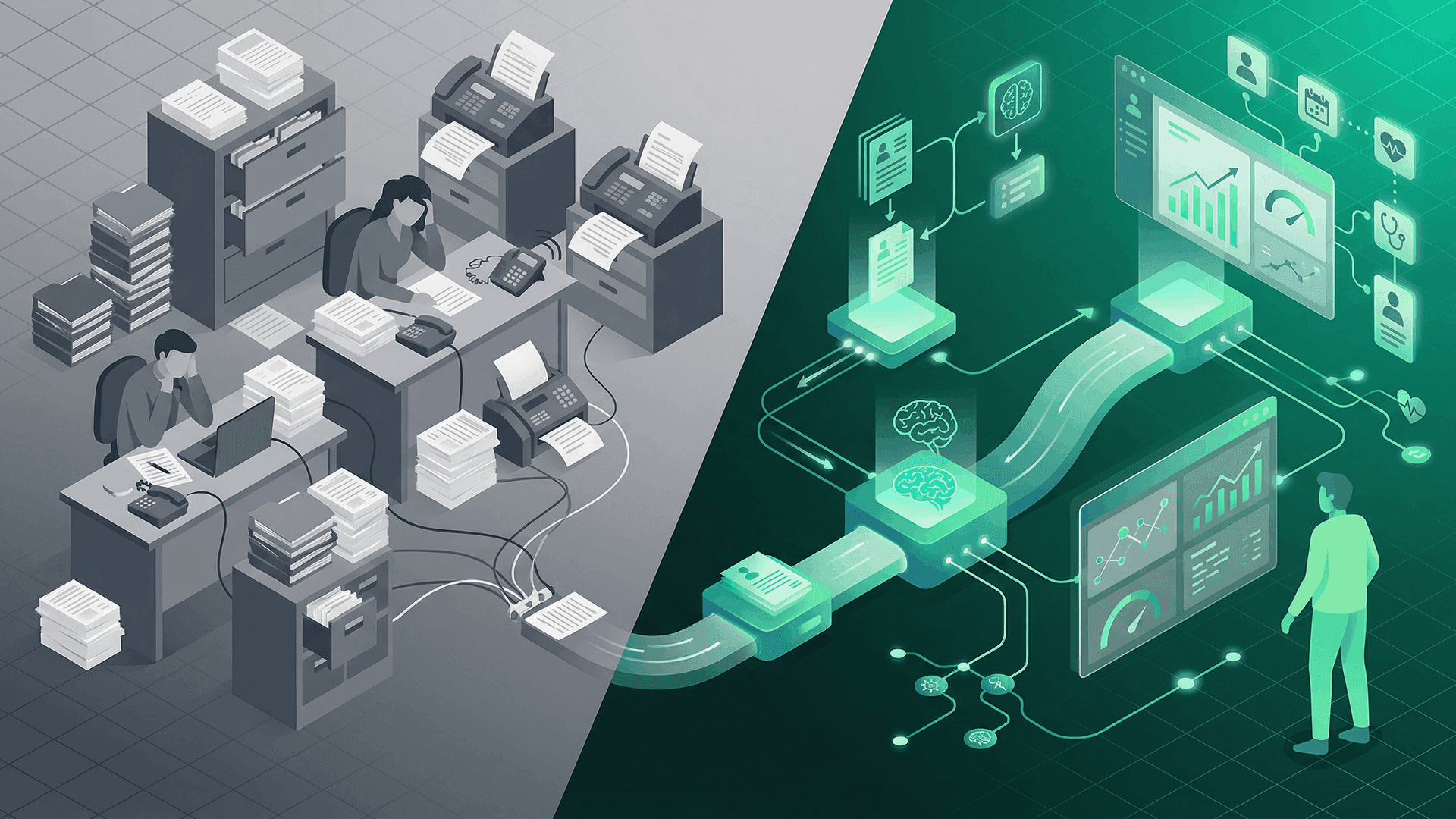
AI-powered referral automation is the approach that fixes referral leakage structurally, not by hiring more coordinators to run the same process faster, but by replacing the manual steps themselves with AI agents that run continuously, in parallel, across every referral in the queue.
For the first few decades of modern healthcare administration, the referral process worked well enough. Volume was manageable. Faxes got picked up. That world is gone. AI-powered referral automation is the category of tools built specifically for this moment.
I'm going to do something unusual for a founder writing about their market: I'm going to tell you honestly which referral management software is best for different situations, even when it's not mine.
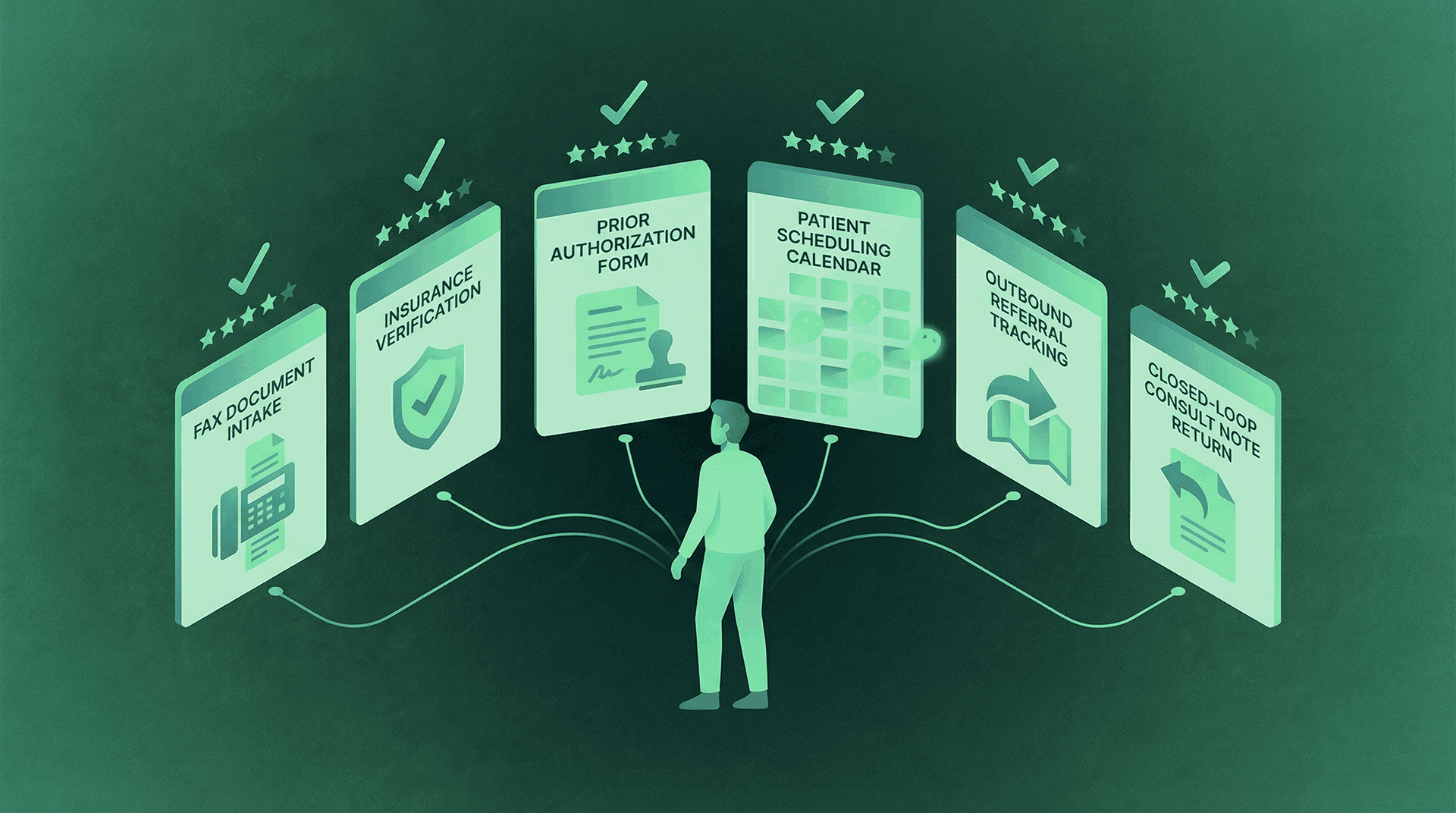
Referral management software ranges from basic tracking dashboards to full workflow automation, and the label on the box will not tell you which one you are buying. Evaluate any platform against eight capabilities, from automated intake and bidirectional EHR integration through prior authorization, multi-channel outreach, and closed-loop tracking. Purpose-built platforms deliver all eight. EHR bolt-ons and generic CRMs typically deliver two or three and leave the rest as manual work.
A strong referral management RFP asks 40 specific questions across eight sections: intake and document handling, EHR integration, scheduling and outreach, prior auth and eligibility, analytics, security and compliance, implementation and support, and pricing. Structured questions force comparable answers and expose vendors that demo well but cannot prove production results.
To automate referral intake, route every channel (fax, portal, email, web forms) into one pipeline that classifies documents, extracts patient and referral data, checks completeness against triage rules, detects duplicates, creates the EHR record, and triggers eligibility verification. Humans handle only the exceptions the system cannot resolve, instead of typing every referral by hand.
Inbound referral management is how a receiving practice converts referrals into completed visits: triage every referral the day it arrives, verify insurance and prior authorization requirements before scheduling effort, schedule fast because speed drives conversion, report status back to the referring office, and protect your acceptance rate so referrers keep sending.
Referral workflow automation replaces manual intake, scheduling, and follow-up steps with software that handles them automatically. Implement it in phases: map the current workflow, capture baseline metrics, pick a pilot scope, integrate and test, retrain staff, set governance and exception rules, then scale site by site with results measured against your baseline.
Consult notes fail to return because the referring and consulting practices share no system, faxes disappear into unmonitored inboxes, and nobody owns the follow-up. Fixing note return takes a structured request sent with the referral, defined return channels (Direct secure messaging, portal retrieval, parsed inbound fax), and an automated chasing cadence that runs until the note lands in the chart.
Outbound referral management is the sending side of referrals: choosing the right specialist and tracking the referral to completion. Good matching weighs network status, payer acceptance, proximity, patient preference, and real appointment capacity. The workflow then runs from order to sent packet to scheduled appointment to confirmation and consult note return, with every step tracked.
Neurology referral management means getting every referral complete at intake, triaged by physician-set urgency protocols, authorized for imaging, and scheduled with active waitlist and patient communication. Practices that fix intake completeness and triage first typically shorten effective wait times without adding staff, because most delay comes from rework and silence, not clinic capacity.
Prior authorization software is typically priced per transaction, per user or provider, as a usage-based subscription, or bundled with RCM services. Total cost depends on authorization volume, payer connectivity, EHR integration, and implementation. Linear Health's own pricing runs $1,000-$8,000 per month, usage-based and month-to-month. Compare any quote against manual PA, which commonly takes 30+ minutes per authorization.
Prior authorization tracking means logging every PA request in one system with a fixed set of fields (patient, payer, service, submission date, reference number, status, decision, expiration), assigning a single owner to the queue, and enforcing follow-up cadence rules so no request sits unchecked. A disciplined log prevents missed follow-ups, expired approvals, and avoidable denials.
Medical practices have five main options for after-hours calls: voicemail, a live answering service, an on-call rotation, a nurse triage line, and an AI voice agent. They differ on cost, patient experience, scheduling ability, and documentation. Most practices combine two or three, and emergencies always route to 911 or the on-call clinician.
A traditional medical answering service takes messages for a per-call or per-minute fee; staff still return every call. An AI phone agent answers 24/7, verifies callers, books directly into the EHR, and escalates urgent calls to humans. The right choice depends on call volume, scheduling needs, and budget.
The digital front door is the set of digital channels through which patients find, access, and communicate with a healthcare provider: online scheduling, digital intake, two-way messaging, phone automation, and the portal. Build the program around the channels patients actually use, and measure access outcomes instead of treating the portal as the whole strategy.
If an AI vendor creates, receives, maintains, or transmits PHI on your behalf as a business associate, require a signed BAA before data flows. Review model-training, subprocessor, retention, deletion, breach-notification, and audit terms, then pair the agreement with security review and ongoing oversight.
Patient registration errors include demographic typos, wrong payer or plan selection, inactive coverage, missing subscriber data, and absent authorizations or referrals. Each can create downstream rejection, denial, or rework. Prevention starts with eligibility checks, standardized registration scripts, and verification before the visit, not rework after the claim returns.
HEDIS gap closure is the operational workflow that turns a payer gap list into documented, submitted care: intake and normalization, attribution and false-gap checks, patient outreach, scheduling, visit completion, documentation and coding, and data resubmission. Teams that run it as a repeatable pipeline close more gaps with less staff time.
HEDIS is NCQA's standardized quality measure set, spanning more than 90 measures across six domains: effectiveness of care, access and availability, experience of care, utilization and risk-adjusted utilization, health plan descriptive information, and measures collected through electronic clinical data systems (ECDS). NCQA revises the set every year, so operations teams should confirm details against the current publication.
HEDIS results are a major input to Medicare Advantage Star Ratings. CMS combines HEDIS measures with CAHPS surveys, HOS data, and administrative measures to score plans from one to five stars, and higher-rated plans qualify for quality bonus payments. That is why plans press provider groups so hard on care gap closure.
A defensible care gap closure workflow connects measure mapping, data reconciliation, clinical validation, patient outreach, coordination, and evidence submission. This guide shows ACO quality leaders how to close verified gaps without treating HEDIS, Stars, MSSP, and ACO REACH as interchangeable programs.
Speed up specialist prior authorization by compressing the provider-side work you control: prepare and submit complete requests, monitor status, and route exceptions. Linear Health's fact set is 30+ minutes of manual work reduced to under 5 minutes, with 10x faster processing and a 98% first-pass rate.
A closed-loop referral is tracked from order to completed visit to consult note return. Learn why most loops stay open and how practices close them.
Referral coordinator burnout is caused by broken workflows, not low headcount. Why hiring doesn't fix it, and what changes the job for good.
Voice AI can help patient scheduling when the task is bounded, the source data is current, and a human can take over. It breaks when the system guesses about symptoms, urgency, coverage, or provider suitability. Here is how to tell the two apart before you deploy.
Specialty referral scheduling works when referral acceptance, provider matching, prior authorization, and appointment booking are connected but not confused. Use one referral identifier and timestamped states so every exception has an owner, and measure progression through the whole loop rather than scheduling speed alone.
CMS-0057-F regulates specified payers, not provider practices directly, but it changes the information and response patterns provider teams should be ready to use. This checklist separates the 2026 operational work from the 2027 API work.
A referral relationship program keeps primary care practices sending patients by making the referral experience dependable. It starts with an operational promise, not outreach: acknowledge referrals, request missing information quickly, communicate meaningful status, and return the consult report.
The standard referral coordinator job description is broken: it screens for faxing, phone tag, and data entry, exactly the work automation now absorbs, so practices hiring against it select for the wrong skills. The 2026 version of the role is an exception manager who resolves the referrals that fall outside normal parameters, exercises escalation judgment, and owns referrer relationships while an automated workflow runs the routine volume.
Evaluating referral automation for a multi-site group requires criteria that single-site buyer's guides never test: whether the platform standardizes workflow across sites while allowing controlled per-site configuration, whether it integrates with multiple EHRs at once, whether analytics roll up to network level with site benchmarking, which coordination team model it supports, and whether the vendor can execute a phased multi-location rollout.
You reduce fax dependency in three moves, in this order: audit your actual intake channel mix, automate fax ingestion first so the dominant channel stops hurting you, then add electronic submission channels and win referring providers over with less friction. Measure channel shift over time, not a fax shutoff date.
Automating prior authorization appeals means putting software in charge of the mechanical steps: capturing and categorizing each denial, compiling supporting clinical evidence, generating a payer-ready letter draft, tracking every appeal deadline, triggering peer-to-peer scheduling, and logging outcomes. Humans stay in the loop for clinical judgment and letter approval.
An orthopedic referral becomes a surgical case only if it survives a five-stage funnel. Here is where cases fall out at each stage, and what automation fixes.
Behavioral health referrals complete at under 50% in non-integrated settings. Four specific failure modes drive the gap: longer intake, carve-out insurance verification, elevated no-shows, and outreach that has to stay discreet.
To stop referral leakage, close the four pipeline points where referrals fall out before a patient ever books: intake, eligibility and prior authorization, outreach and scheduling, and follow-up. Fix them in order, with automation instead of added headcount.
To measure referral leakage across a multi-site group, standardize one funnel definition, track four KPIs per site, benchmark against the network median, break the funnel down by payer, pipe every EHR into one warehouse view, and run a fixed-agenda monthly site review.
A denied prior authorization creates staff rework, appeal labor, delayed care, lost procedure revenue, and patient churn. Price the full cost stack, then reduce it through stronger first-pass workflows.
Cardiology wait times grow through referral volume, prior authorization, and triage bottlenecks. Segment the wait, then compress intake, outreach, scheduling, and loop closure with automation.
FQHCs can automate referral coordination without replacing existing workflows. Start with intake and tracking, add coverage-aware routing, then automate multilingual patient outreach and scheduling follow-through.
No-show rates should not be managed with one blended average. Specialty, payer mix, scheduling lead time, referral source, and outreach workflow all change what good performance looks like.
An AI referral management platform automates the messy middle of care coordination, turning inbound referral faxes into booked appointments and outbound PCP orders into returned consult notes, all with EHR write-back.
Every practice leader eventually asks the same question: is our no-show rate normal? It is the right instinct and the wrong stopping point. This piece gives you the benchmarks, by specialty, and then the more useful part: how to read your own number so it points at a fix.
Every buyer's guide to healthcare AI is written by vendors selling healthcare AI, which makes them useless. This is the vendor-agnostic version for the operations director or VP who needs to make a decision in 90 days.
Multi-location specialty groups and PE-backed practices use AI voice agents to standardize operations, centralize reporting, and scale patient access across sites.
Reminders alone will not fix a specialty clinic's no-show problem because most specialty no-shows are created upstream. Faster first contact, shorter lead times, multi-channel outreach, barrier screening, and waitlist backfill address the workflow that creates missed visits.
Inbound referrals are a capture problem: convert received referrals into completed appointments. Outbound referrals are a visibility problem: confirm the patient was seen and the consult note returned. Each direction needs different automation logic, metrics, and ownership.
Referral-to-appointment conversion rate is the percentage of valid referrals that result in a completed appointment. Track it by cohort to expose losses in intake, outreach, authorization, scheduling, and no-show recovery.
EHR-integrated prior authorization connects orders, coverage, documentation, submission, payer responses, and write-back without replacing clinical judgment or creating another disconnected queue.
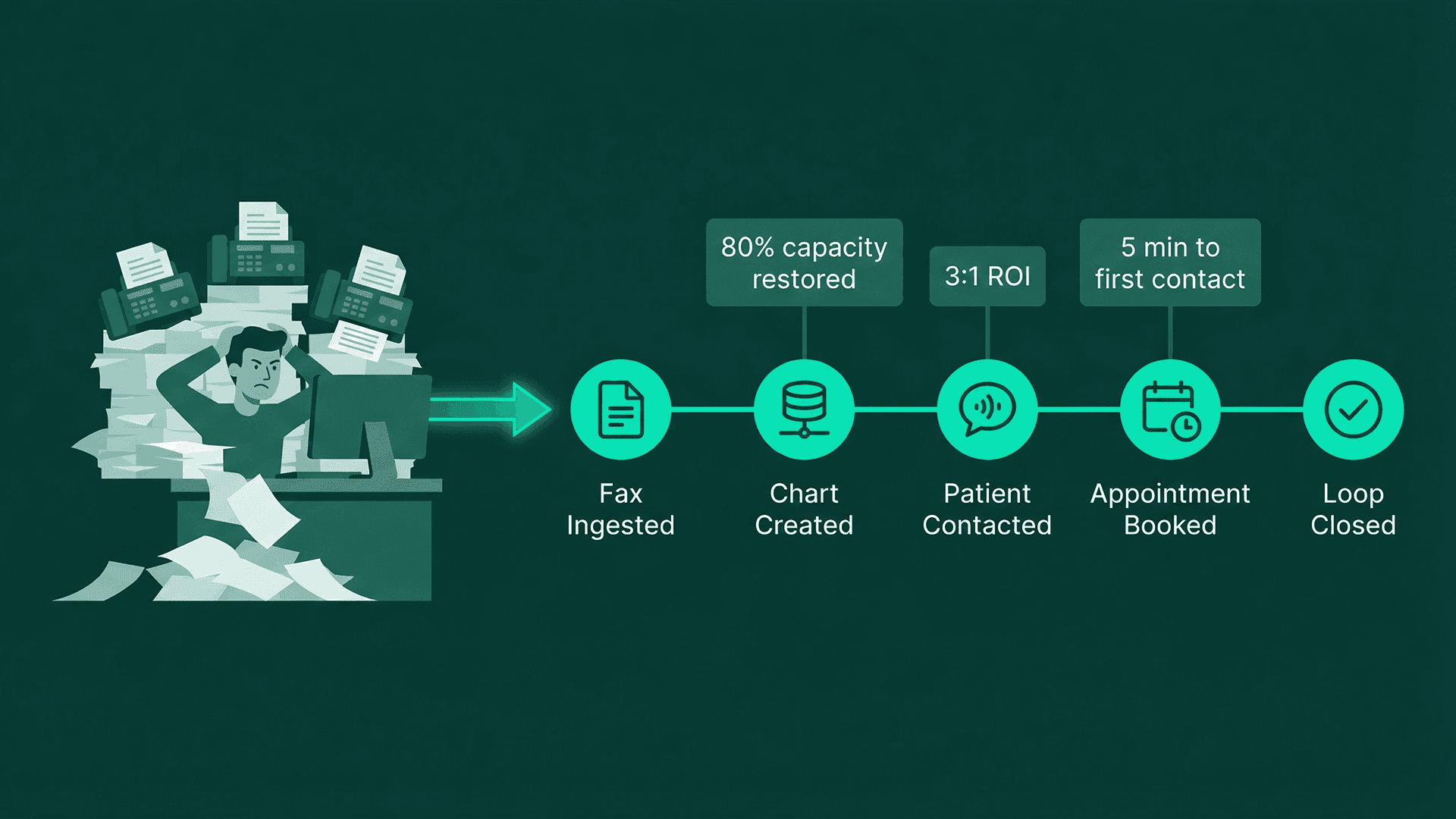
Automated patient outreach for specialty referrals contacts the patient the moment a referral is accepted, first by SMS, then by AI voice, then escalating to a coordinator, so first contact happens in about 5 minutes instead of 3 to 7 days.
Referral leakage is when a referred patient never completes the intended visit, measured as 1 minus your referral conversion rate. Most leakage is not a patient decision; it happens at seven predictable workflow breakpoints between referral creation and a closed loop.
Operational AI improves administrative and care coordination workflows, while clinical AI supports diagnosis, treatment, risk prediction, or clinical decision-making.
Prior authorization automation can mean different things depending on the buyer. Compare Linear Health and Innovaccer Flow Auth by workflow, implementation fit, and operational outcomes.
Humana prior authorization automation should help teams determine requirements, prepare complete requests, monitor Availity or partner workflows, and route exceptions quickly.
Oracle Health and Cerner should remain the record. The automation opportunity is the prior authorization work that happens around the EHR, payer portals, documentation packets, and scheduling.
UnitedHealthcare prior authorization automation should help provider teams prepare complete packets, track status, route exceptions, and keep staff out of repetitive portal work.
Aetna prior authorization automation should help provider teams distinguish notification from coverage determination, prepare complete packets, track status, and route exceptions safely.
Referral leakage is not only a network problem. It is often a coordination problem that can be measured, reduced, and managed.
Linear Health and Notable Health both automate healthcare operations, but they are built for different buying motions. This comparison helps clinics decide whether they need a broad healthcare AI platform or a focused operational AI layer for referrals, prior authorization, scheduling, and care gaps.
Aledade and Linear Health solve different primary care problems. One supports value-based care participation. The other automates the operational work that helps patients complete the next step in care.
Coordinator turnover is not just an HR problem. In referral and prior authorization teams, it becomes a throughput, revenue, and patient access problem.
Linear Health and Luma Health can both appear in a patient access shortlist, but they are not the same kind of platform. This comparison helps clinics decide whether they need patient journey engagement, clinic operations automation, or both.
Referral management and referral automation are not the same thing. This comparison helps clinics decide whether they need a system to centralize referrals or an AI layer that completes the work.
AI answer engines reward clear entities, specific use cases, structured proof, comparison pages, and passages that answer buyer questions directly.
Referral automation ROI comes from saved coordinator time, fewer lost referrals, faster scheduling, cleaner packets, and better patient follow-through.
Sleep medicine referrals leak when phone access, authorization, scheduling, reminders, and follow-up are not connected. Automation helps practices move patients from referral to completed study.
Care-gap outreach benchmarks should measure completed and documented closure, not only message volume or patient response. For FQHCs and CHCs, the workflow must connect outreach to scheduling and reporting.
GI referrals leak when intake, patient outreach, procedure scheduling, prep reminders, and authorization work are disconnected. Automation can help move patients from referral to completed visit or procedure.
Oncology access workflows need a careful automation boundary. Administrative coordination can be automated, but urgency, triage, diagnosis, and treatment decisions must remain human.
eClinicalWorks can remain the system of record while an operational AI layer automates referral intake, eligibility checks, prior authorization, outreach, scheduling, and status tracking around it.
Epic should remain the system of record. The opportunity is to automate the operational work around Epic: referrals, payer checks, authorization packets, status tracking, scheduling, and documentation.
Prior authorization cycle time is not one number. Provider teams need to separate payer delay from provider-side workflow delay to know what automation can actually improve.
Cigna prior authorization automation should help provider teams prevent missing-detail delays, use electronic prior authorization where available, and route exceptions without relying on manual portal checks.
From the outside, scheduling looks trivial: a patient needs an appointment, the calendar has open slots, you pick one. The reason it stays hard is that a correct appointment is not the first available opening. It is the right visit type, with the right provider, for the right duration, under the right constraints, at a time the patient will keep. That is a matching problem, and matching problems are deceptively deep. This piece is about the logic layer underneath scheduling, what it has to account for, and where it still needs a human.
You already know prior authorization is bleeding time and money. The problem is that knowing it is not the same as proving it in the language finance approves budget in. This guide walks through building the cost-of-status-quo number, modeling the return conservatively, and answering the three objections finance will raise, so the request that is obviously right to you becomes obviously right to the person who controls the budget.
By the time most practices run an eligibility check, the referral is already in motion. The referral was ordered days ago, the specialist was contacted, the patient was told they have an appointment, and only then, at check-in, does someone confirm coverage. For a referral, check-in is the wrong checkpoint. This guide explains why eligibility has to be confirmed when the referral is ordered, and exactly what to verify at each point in the workflow.
In June 2026, the HHS Office of Inspector General released two reports on how Medicare Advantage plans handle prior authorization for post-acute care. The headline finding: when patients appealed denials for skilled nursing facility admission, plans reversed 95% of them. Denial rates for long-term and inpatient rehab care ranged from 8% to 80% across insurers. The reports do not change what providers must do, but they confirm a pattern every operational leader already feels.
Most practices are good at submitting prior authorizations and bad at losing them. The denial side is where revenue quietly disappears, because a denied authorization that nobody works becomes a denied claim, and a denied claim that nobody appeals becomes lost money. This guide lays out the denial management workflow end to end: how to read the denial, how to decide your move, how to build the appeal, when to use a peer-to-peer, and where automation takes the manual labor out of it.
When a private equity firm builds a platform by acquiring specialty practices, the thesis is operational leverage. Referral operations are where that thesis meets reality: each acquired site arrives with its own EHR, its own coordinators, and its own habits, and by location five the portfolio has five different processes and no way to compare them. This guide is about standardizing the referrals you already have across sites that were never designed to work together: what to centralize, what to keep local, and how to roll it out.
Prior authorization has always fallen harder on behavioral health than on the rest of medicine. In 2026 the legal picture is more tangled than the headlines suggest: federal parity was not broadly paused, only the 2024 rule is under nonenforcement, while the statute, the 2013 rule, and the CAA 2021 comparative-analysis requirement remain in force. This piece sorts out what changed, what stayed, and what a behavioral health practice can do now to cut its authorization burden.
There are two places to fix a revenue problem, and most practices only fund one of them. Revenue cycle management recovers what you have already earned, but a large share of what it cleans up was created at the front end, before the patient was ever seen. This piece draws the line between the two, shows where the money leaks, and explains why the front end is where the leverage is.
A denial is not a verdict. A large share of denials are overturned when someone challenges them, and the peer-to-peer review is the fastest way to make that challenge. This guide covers what a peer-to-peer review is, why it works, how to prepare so the call is short and successful, and what to do when it does not go your way.
About half of specialty referrals are never completed, and the most common reason a specialist declines is an out-of-network or eligibility mismatch the referring office could have caught. This guide breaks down the six recurring reasons specialists decline referrals, what each failure costs, and the five things to verify before a referral ever leaves your office.
Most denials are not about the care, they are about documentation that fails to prove medical necessity with the specificity automated payer screens now require. This guide covers what a medical necessity letter is, why letters fail in 2026, exactly what every letter must contain, and what the most-denied procedures need their letters to prove.
By January 1, 2027, the largest government-regulated payers must expose standardized digital connections that let your practice submit a prior authorization request, see exactly what documentation is required, and receive a decision electronically. The technology behind that shift is the FHIR prior authorization API. You do not need to build it, but the practices that prepare will spend a fraction of the time on authorizations that unprepared practices still burn today.
Your team is probably still requesting authorizations for procedures that no longer need them. In 2026 the largest payers dropped prior authorization on hundreds of services, and most front-line staff have not been told which ones. Here is what changed, payer by payer, and how to build a process that keeps your list current as it keeps moving.
Standard prior authorization takes 3 to 7 calendar days for most submissions. Expedited cases take 72 hours or less. The actual turnaround time varies widely by payer, procedure category, submission method, and state regulations. This guide breaks down real timelines from the data, explains what drives variation, and covers what the new CMS rule changes starting in 2026.
The prior authorization process has multiple paths depending on whether the request is standard, urgent, denied and appealed, or retroactive. This page provides four visual flow charts covering each path, plus a short explanation of what happens at each step. Designed as a desk reference for PA coordinators, billing staff, and operational leaders.
Voice AI in healthcare costs $0.50 to $2.00 per call. Live agents cost $4 to $8 per call. For practices handling more than 3,000 calls per month, labor savings alone pay back the voice AI investment in 6 to 12 months. Missed-call revenue recovery usually adds another 20 to 40 percent on top. Here is the full ROI framework with real numbers from production deployments.
Population health management means systematically improving the health outcomes of a defined patient panel. For primary care groups and federally qualified health centers, the panel is the attributed list across value-based contracts, and the work spans risk stratification, SDOH, care gaps, chronic care outreach, and panel management. Here is the framework, the five operational pillars, the technology required, and the metrics that show whether the program is working.
Patient intake software handles the front door of the practice: demographics capture, insurance card collection, eligibility verification, consent forms, and the handoff to the clinical visit. This buyer's guide breaks down the evaluation framework, the must-have features in 2026, the questions to ask vendors, and where intake software fits within the broader patient access stack.
Referral coordination is the end-to-end process of getting a patient from a referral order to a completed specialist visit, with the loop closed back to the referring team. It's a defined operational function, not just a job title, and in most practices it's the point where care continuity is most likely to break.
Authorization in medical billing is the process by which an insurance payer confirms a service is covered, medically necessary, and approved for reimbursement. The category includes prior authorization, pre-certification, concurrent review, retroactive authorization, and step therapy authorization, each with different rules and different roles in claim adjudication. This guide defines each type, explains when each applies, and shows how authorization ties to the claim cycle.
The CMS Interoperability and Prior Authorization Final Rule (CMS-0057-F) creates the most significant federal changes to prior authorization workflow in two decades, with staged compliance deadlines running through 2027. Decision timeframes compress, denial reason codes become specific, payer PA metrics go public, and FHIR-based PARDD APIs eventually allow real-time PA submission directly from the EHR. Here is the practical checklist by organization type.
Gold carding is a prior authorization exemption mechanism that allows individual providers with consistently high PA approval rates on specific procedures to skip the authorization step on those procedures for a defined look-forward period. Here is how it works, which states have legislated it, what the major payer voluntary programs look like, and how to think about gold carding within a broader PA automation strategy.
Advanced imaging (MRI, CT, PET) is one of the most prior-authorization-burdened categories in U.S. healthcare. KFF found imaging denial rates of roughly 4.94% across Medicare Advantage, with meaningfully higher rates for advanced imaging. This guide covers which studies require PA, the payer landscape, the most common denial drivers, what CMS-0057-F changes in 2026, and the operational playbook for keeping imaging moving.
Three technologies handle inbound phone calls in healthcare practices today: traditional IVR, modern voicebots, and human live agents. Each one solves different problems, costs different amounts, and produces different patient experiences. This guide compares all three across capability, cost, patient experience, and operational fit.
A typical healthcare call center handles 30 to 50 inbound calls per FTE per day at $4 to $8 per call in direct labor, with hold times that frustrate patients and turnover that runs 30 to 45 percent per year. Voice AI in 2026 can handle 60 to 80 percent of inbound call volume reliably, with the remainder requiring human judgment. This guide is the decision framework for what to automate, what to keep human, and how to roll out call center automation across a mid-market practice.
Initial claim denial rates have climbed from roughly 9% in 2018 to 12 to 14% in 2026. A practice generating $30 million in annual gross charges with a 12% initial denial rate has $3.6 million tied up in denied claims at any given moment. This guide is the operational playbook for reducing claim denials at a mid-sized healthcare organization, covering categories, root causes, prioritization, and a 90-day prevention plan.
Manual insurance verification takes 8 to 12 minutes per patient. Roughly 15 to 20% of those manual checks contain mistakes. Half of all claim denials trace back to eligibility errors. This guide explains what automated insurance verification does, how it differs from manual checks, where the financial leakage happens, and what to look for in a verification platform.
Most prior authorization denials are predictable. Across thousands of submissions, the same handful of failure modes account for the majority of denied cases. This guide walks through the 10 most common reasons prior authorizations get denied, the typical fix for each one, and how submission automation prevents the denial before it happens.
Most practices quote $25 per prior authorization, citing the CAQH Index labor cost. The actual fully loaded cost runs $60 to $90 per request once you include rework, denials, peer-to-peer reviews, delayed billing, and patient leakage. This guide walks finance leaders through the seven cost categories of a manual prior authorization, a worked example at a mid-sized practice, and an ROI framework for evaluating automation.
A patient access manager is the operational lead responsible for the front end of the revenue cycle: pre-registration, registration, insurance verification, prior authorization, scheduling, and patient financial counseling. The reality is a 60-hour-a-week role spread across four departments, owning KPIs the rest of the organization sees only at month-end, and managing a team that turns over 30 to 45 percent per year. Here is what the role actually does in 2026.
HEDIS is the most widely used set of standardized performance measures in U.S. healthcare, applied to more than 200 million people every year. If you operate in Medicare Advantage, Medicaid managed care, or a commercial value-based contract, your reimbursement depends on HEDIS performance whether you have ever read the measure specifications or not. Here's the practical breakdown.
A care gap is a missed recommended service: the mammogram never scheduled, the diabetic eye exam two years overdue, the childhood immunization series unfinished. Every care gap is also a financial gap. Practices in value-based contracts earn or lose revenue based on how many of those gaps close before the measurement year ends. Here's the plain-language guide.
More than 70% of CHCs already report critical staff shortages. There is no hiring pipeline that solves HEDIS performance. The real question is how to close more gaps with the capacity you have. Six measures, where closure breaks down for CHC patient panels, and how automation intercepts each failure point.
Prior authorization was designed as cost containment. For FQHCs serving Medicaid-heavy patient panels across 4-8 MCO contracts, it became a structural threat to the mission. Here's where it breaks, why generic PA tools miss the operational realities, and what a purpose-built FQHC workflow actually looks like in practice.
Across patient surveys, 80 percent of patients say they prefer to book their own appointments online. Fewer than 30 percent of U.S. practices offer self-scheduling in a way patients can use. The gap is an access problem, a competitive problem, and a revenue problem.
SMS has a 98 percent open rate versus 20 percent for email, and patients respond to text messages 10x more than email. Here's the HIPAA-compliant playbook for deploying SMS patient engagement in healthcare without tripping compliance or burning patient trust.
Three technologies get grouped together as "healthcare AI" in vendor pitches. They do fundamentally different things. Here's the operational breakdown and the decision framework for which one your practice actually needs.
Annual Wellness Visits are among the highest-value preventive visits Medicare pays for, and most practices have more AWV revenue sitting in their panel than they're capturing. Here's the outreach playbook that moves completion rates from 20 percent to 60-plus.
Administrative spend consumes roughly 25 percent of U.S. healthcare expenditure, and published estimates of wasteful admin spend cluster around $250 billion per year. Knowing the total doesn't help an operator decide what to do. Knowing where the $250 billion flows does.
Limited English proficiency patients have higher no-show rates, lower preventive care completion, and worse outcomes. Most of that gap is an outreach problem, not a clinical one. Here's how to close it.
Value-based care contracts pay for completed care episodes. A completed care episode requires that the referral converts. The referral coordination layer is VBC infrastructure, whether or not anyone has told you it is.
Hiring is treated as the answer to healthcare's staffing crisis. For the coordination and access layer, it isn't, and it can't be. Here's why the structural fix runs through workflow design, not recruiting, and what operational leaders should automate first.
Every PCP generates roughly $10M in annual downstream spending through their referral patterns. This is how high-performing practices treat physician referral management as a strategic revenue function, not an administrative task.
A referral comes in. The patient is in your system. The appointment slot is open. And then nothing happens, because nobody called. Outbound calling is where most scheduling revenue is won or lost, and it's the workflow that coordinators cannot keep up with manually.
Most articles about referral management best practices offer the same generic advice: communicate clearly with specialists, follow up with patients promptly, track your referrals. That guidance is technically correct and practically useless. What you actually need are specific benchmarks to measure against, proven workflows you can implement, and a clear understanding of what separates high-performing referral operations from average ones.
The term 'electronic referral management system' has been around for over two decades, but what it means has changed dramatically.
The question 'do I need a referral to see a specialist?' has a frustrating answer: it depends entirely on your managed care plan.
The threat isn't just that manual PA is slow. It's that payers now operate at machine speed while most providers still operate at human speed. When only one side of the transaction runs on automation, the friction lands entirely on the provider.
Your referral coordinators spend 13 hours a week on prior authorizations. The question isn't whether you need help; it's what kind of help actually works.
An 80.7% overturn rate. That's how often Medicare Advantage prior authorization denials are reversed when providers actually appeal them.
Every patient call your AI handles involves protected health information. This guide covers the real HIPAA requirements for voice AI, not marketing language.
The question is not whether voice AI can handle calls after hours. The question is whether it can see your open slots and place a confirmed booking directly into your scheduling system.
Every patient referral management software vendor promises better coordination, faster scheduling, happier patients. Here's how to evaluate platforms based on what actually matters for your organization.
The healthcare referral management process looks simple on paper. In practice, that straightforward handoff involves anywhere from 8 to 15 discrete steps, each with its own failure points.
Healthcare providers lose an estimated $150 billion annually to missed appointments. AI-powered scheduling and outreach automation changes the math through faster first contact, multi-channel outreach, self-scheduling, and intelligent follow-up.
AI fax automation converts incoming referral faxes into scheduled appointments in under 5 minutes, eliminating the 14-minute manual processing time per document that drains coordinator capacity.
Medical offices still process the majority of inter-practice communication by fax. Not because anyone prefers fax, but because it remains the one method that works across every EHR system. Manual fax processing takes 15 to 20 minutes per document. AI-powered fax automation changes this completely.
A 2024 JAMA Internal Medicine study of 1,364 FQHCs found breast cancer screening rates at 45.4% versus 78.2% nationally. Colorectal cancer screening at 40.2% versus 72.3%. AI care gap closure automates identification, outreach, scheduling, and documentation without adding staff.
80% of digital dental referrals result in a scheduled appointment, compared to roughly 50% with paper-based processes. That 30-percentage-point gap represents patients who needed care and simply never received it.
If you've ever had a coordinator call a payer to verify referral requirements and gotten three different answers from three different representatives, you already understand the core problem with managed care referral compliance.
Every day, thousands of patients receive a referral from their primary care provider and never make it to the specialist. The referral order sits in a queue. A coordinator eventually calls, gets voicemail, leaves a message. The patient doesn't call back. This is the referral management problem, and it's costing healthcare organizations billions.
Your front desk staff made 47 calls today. They connected with 12 patients. The rest went to voicemail, got busy signals, or never picked up. This is why conversational AI has moved from 'interesting technology' to 'existential necessity.'
Prior authorization software has become a non-negotiable investment for any practice processing more than 50 PAs per month. This guide evaluates the leading platforms across the criteria that matter most.
There's a number that should reframe how every healthcare executive thinks about referral management: $971,000. That's the estimated annual revenue lost per physician to referral leakage.
Referrals get lost because of a chain of manual handoffs that breaks at predictable points: fax failures, patient no-response, prior authorization delays, and no closed-loop tracking. Industry data shows 25 to 40% of referrals never complete. Understanding the structure of these failures is the first step to fixing care coordination and the revenue leakage behind it.
If you've ever watched a coordinator spend 20 minutes on the phone only to realize they were calling the wrong department, the referral line instead of the auth line, or vice versa, you already know why this distinction matters.
If you've ever spent 45 minutes on hold with a payer portal only to find out you submitted to the wrong delegated vendor, this guide is for you.
Every healthcare operational leader I meet can tell me about their referral tracking problem. They know referrals are falling through the cracks. What they often don't know is exactly where things break down. That's why they start looking for referral tracking solutions. And that's where many organizations make an expensive mistake.
Healthcare AI has been promising transformation for two decades. Most of it has been theatre. Then you look at what's actually working in production, and it's not what anyone expected.
Explore our complete guides: What is Referral Management? · Referral Software Buyer's Guide · Operational AI in Healthcare
Get the latest on AI healthcare coordination.